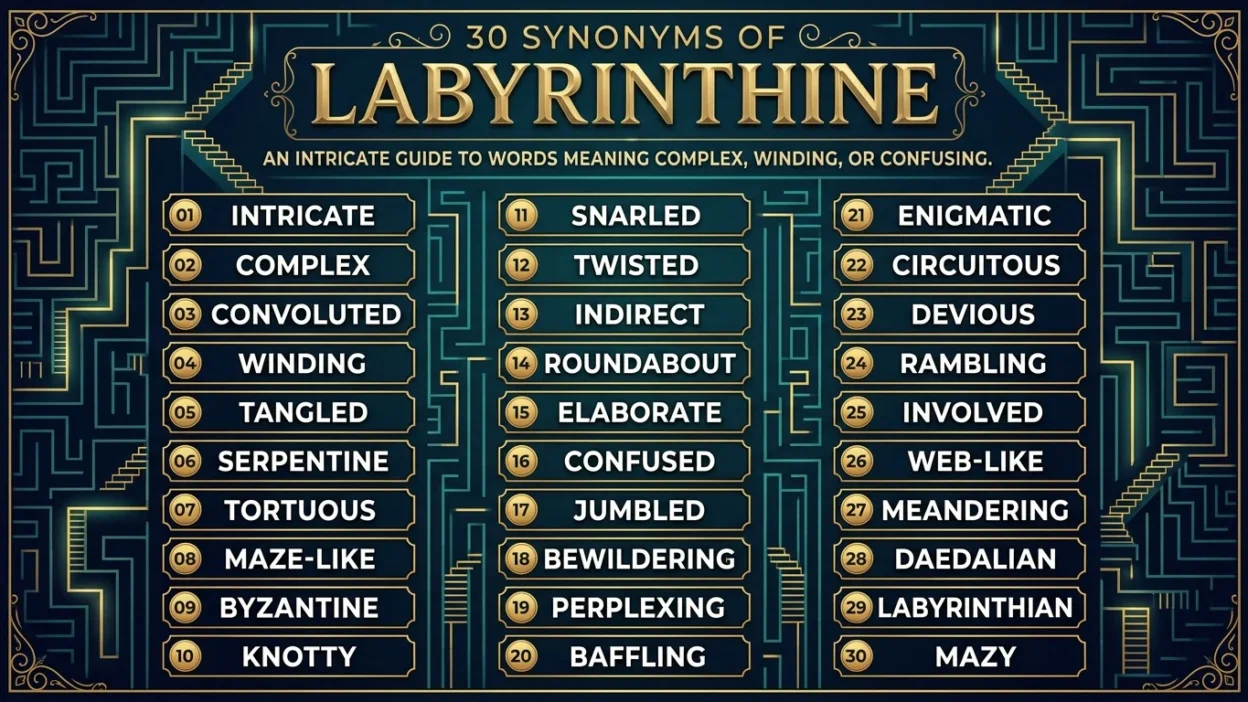
The word labyrinthine describes something complicated, confusing, or full of winding paths and interconnected parts. Common synonyms of labyrinthine include complex, intricate, convoluted, complicated, maze-like, tangled, bewildering, and byzantine. These words can describe physical places, difficult systems, confusing instructions, complicated stories, or problems that are hard to understand.
Choosing the right synonym depends on what you want to express. For example, intricate often suggests impressive detail, while convoluted usually emphasizes unnecessary complexity. This guide explains 30 useful synonyms of labyrinthine, with simple definitions, example sentences, and practical advice for choosing the best word.
Quick Answer: What Are the Best Synonyms of Labyrinthine?
The best synonyms of labyrinthine are:
- Complex
- Complicated
- Intricate
- Convoluted
- Maze-like
- Tangled
- Bewildering
- Confusing
- Byzantine
- Winding
- Meandering
- Knotty
- Involved
- Elaborate
- Twisting
- Interwoven
- Interconnected
- Perplexing
- Puzzling
- Obscure
- Opaque
- Baroque
- Esoteric
- Multifaceted
- Multifurcated
- Circuitous
- Gordian
- Imbricated
- Complicatedly structured
- Hard to navigate
The closest synonym depends on the context. Use maze-like for physical layouts, intricate for detailed structures, convoluted for unnecessarily complicated explanations, and bewildering for something that leaves people confused.
What Does Labyrinthine Mean?
Labyrinthine is an adjective used to describe something that resembles a labyrinth, or maze, because it has many winding paths, complicated connections, or confusing details.
The word can refer to both physical and abstract things.
Simple Definition
In simple English, labyrinthine means very complicated, winding, or difficult to understand or navigate.
Examples:
- The old castle had a labyrinthine network of underground passages.
- The legal process was so labyrinthine that the family needed professional help.
- She struggled to understand the labyrinthine plot of the novel.
In the first sentence, labyrinthine describes a physical place. In the second and third sentences, it describes complicated systems and ideas.
Origin of the Word
The word labyrinthine comes from labyrinth, a term for a maze or an intricate network of passages. It is often used in literature, architecture, law, administration, technology, and everyday conversation.
When Should You Use Labyrinthine?
Use labyrinthine when you want to emphasize one or more of these qualities:
- Complexity: Something contains many parts or relationships.
- Confusion: It is difficult to understand what is happening.
- Winding structure: A physical route has many turns and passages.
- Interconnectedness: Different parts are linked in complicated ways.
- Difficulty navigating: Finding the correct route or solution is challenging.
The word often has a negative tone when describing bureaucracy or instructions. However, it can also suggest beauty, richness, or fascinating detail when describing architecture, art, or storytelling.
30 Synonyms of Labyrinthine With Meanings and Examples
The following words are useful alternatives to labyrinthine. Some are close synonyms, while others describe a particular aspect of labyrinthine complexity.
1. Complex
Simple meaning: Made up of many connected parts; not simple.
Example: The company developed a complex system for managing international orders.
Best usage/context: Use complex in academic writing, professional communication, science, technology, and everyday explanations. It is a broad, neutral alternative to labyrinthine.
2. Complicated
Simple meaning: Difficult to understand, explain, or manage.
Example: The complicated application process discouraged many students.
Best usage/context: Use complicated when you want to emphasize difficulty rather than physical structure. It is one of the easiest synonyms for beginners.
3. Intricate
Simple meaning: Having many small details or carefully connected parts.
Example: The artist created an intricate design inspired by traditional patterns.
Best usage/context: Use intricate when complexity involves skill, precision, beauty, or detailed construction. It often sounds more positive than complicated.
4. Convoluted
Simple meaning: Extremely complicated, often in an unnecessary or confusing way.
Example: His convoluted explanation made a simple problem seem impossible.
Best usage/context: Use convoluted for confusing arguments, sentences, plots, procedures, and explanations. It often expresses criticism.
5. Maze-like
Simple meaning: Resembling a maze with many turns, routes, or confusing connections.
Example: The shopping center had a maze-like layout that confused first-time visitors.
Best usage/context: Use maze-like for buildings, corridors, streets, gardens, and systems that are difficult to navigate. It is one of the closest alternatives when the physical structure matters.
6. Tangled
Simple meaning: Twisted together or mixed up in a confusing way.
Example: The investigation uncovered a tangled network of financial relationships.
Best usage/context: Use tangled for relationships, disputes, stories, cables, and complicated situations. It suggests disorder as well as complexity.
7. Bewildering
Simple meaning: So confusing that it leaves someone puzzled or uncertain.
Example: The number of rules was bewildering to new employees.
Best usage/context: Use bewildering when you want to emphasize a person’s reaction to something complicated. It is particularly useful in descriptive and narrative writing.
8. Confusing
Simple meaning: Difficult to understand or follow.
Example: The website presented its information in a confusing order.
Best usage/context: Use confusing in everyday English, classroom explanations, instructions, and user feedback. It is simpler and more direct than labyrinthine.
9. Byzantine
Simple meaning: Extremely complicated, especially because of many rules, procedures, or political relationships.
Example: The organization struggled with a Byzantine system of approval.
Best usage/context: Use Byzantine in formal writing about bureaucracy, regulations, administration, or political systems. It can sound sophisticated but may be unfamiliar to some readers.
10. Winding
Simple meaning: Following a twisting or curving route rather than a straight line.
Example: A winding path led visitors through the ancient garden.
Best usage/context: Use winding mainly for roads, paths, rivers, staircases, and passages. Unlike labyrinthine, it does not necessarily imply confusion.
11. Meandering
Simple meaning: Following a winding or indirect course.
Example: The meandering passage through the forest eventually reached a quiet lake.
Best usage/context: Use meandering for routes, rivers, conversations, and pieces of writing that move indirectly from one point to another.
12. Knotty
Simple meaning: Difficult to solve or understand.
Example: The researchers spent months working on a knotty scientific problem.
Best usage/context: Use knotty for challenging questions, legal issues, intellectual problems, and difficult decisions. It emphasizes the challenge of finding a solution.
13. Involved
Simple meaning: Complicated because many details, people, or stages are included.
Example: The project required an involved process of testing and approval.
Best usage/context: Use involved in formal or professional contexts when describing procedures, arrangements, or tasks with many parts.
14. Elaborate
Simple meaning: Carefully developed with many details or parts.
Example: The architect presented an elaborate plan for the new museum.
Best usage/context: Use elaborate when complexity results from extensive planning, decoration, or detail. It can be positive and does not automatically mean confusing.
15. Twisting
Simple meaning: Turning repeatedly in different directions.
Example: The explorers followed a twisting passage beneath the mountain.
Best usage/context: Use twisting for physical routes, corridors, tunnels, and shapes. It may also describe a story or argument that takes unexpected turns.
16. Interwoven
Simple meaning: Closely connected or mixed together.
Example: The novel explores several interwoven stories about family and friendship.
Best usage/context: Use interwoven when different ideas, events, themes, or relationships are linked. It emphasizes connections more than difficulty.
17. Interconnected
Simple meaning: Linked to one another in a network or system.
Example: Modern cities depend on interconnected transportation and communication networks.
Best usage/context: Use interconnected for systems, networks, organizations, ideas, and relationships. It is a good choice when the complexity comes from many links between parts.
18. Perplexing
Simple meaning: Difficult to understand or explain.
Example: The sudden change in the results presented a perplexing problem.
Best usage/context: Use perplexing for mysteries, questions, discoveries, and situations that are hard to explain. It emphasizes uncertainty.
19. Puzzling
Simple meaning: Strange or confusing in a way that makes people think carefully.
Example: The detective discovered a puzzling clue near the entrance.
Best usage/context: Use puzzling in everyday conversation, mysteries, educational contexts, and descriptions of unusual events. It is generally less formal than perplexing.
20. Obscure
Simple meaning: Difficult to understand, recognize, or discover.
Example: The manual contained obscure instructions that few users could follow.
Best usage/context: Use obscure when the main problem is a lack of clarity or accessibility. It can also mean little-known, so the surrounding sentence should make your intended meaning clear.
21. Opaque
Simple meaning: Difficult to understand or not clearly explained.
Example: The agency used an opaque process for making important decisions.
Best usage/context: Use opaque for policies, language, reasoning, systems, and decision-making processes that are not transparent. It is especially useful in formal and analytical writing.
22. Baroque
Simple meaning: Highly elaborate, ornate, or complicated in style.
Example: The palace featured baroque decorations and elaborate architectural details.
Best usage/context: Use baroque for art, architecture, writing, design, or elaborate systems. It can be figurative, but it is not a general substitute for every use of labyrinthine.
23. Esoteric
Simple meaning: Understood by only a small group of people with specialized knowledge.
Example: The lecture included esoteric terminology that beginners found difficult to follow.
Best usage/context: Use esoteric for specialized knowledge, technical language, theories, and subjects unfamiliar to most people. It emphasizes limited accessibility rather than complicated structure.
24. Multifaceted
Simple meaning: Having many different aspects or sides.
Example: Climate change is a multifaceted issue involving science, economics, and public policy.
Best usage/context: Use multifaceted for subjects, challenges, people, and problems with many dimensions. It is often neutral or positive.
25. Multifurcated
Simple meaning: Divided into several branches or separate paths.
Example: The multifurcated route split into several narrow passages.
Best usage/context: Use multifurcated in specialized, technical, or highly descriptive writing when something branches into multiple directions. It is uncommon in everyday English and is not a general synonym for labyrinthine.
26. Circuitous
Simple meaning: Taking a longer or less direct route than necessary.
Example: The hikers followed a circuitous trail to avoid the steep cliff.
Best usage/context: Use circuitous for indirect routes, arguments, explanations, and methods. It emphasizes lack of directness rather than the number of details.
27. Gordian
Simple meaning: Extremely difficult or complicated, especially in the expression “Gordian knot.”
Example: The negotiators faced a Gordian problem involving several competing demands.
Best usage/context: Use Gordian in literary, historical, or rhetorical writing. It is most natural in the established expression Gordian knot, which refers to a seemingly impossible problem.
28. Imbricated
Simple meaning: Overlapping or arranged so that parts cover one another.
Example: The report described imbricated layers of responsibility within the organization.
Best usage/context: Use imbricated in specialized academic, technical, or descriptive writing when parts overlap or fit together in layers. It is not a common everyday replacement for labyrinthine.
29. Complicatedly structured
Simple meaning: Organized in a way that contains many difficult or connected parts.
Example: The complicatedly structured database required careful planning before any changes could be made.
Best usage/context: Use this phrase when you need to describe an arrangement or system whose structure is difficult to follow. In polished writing, complexly structured or intricately structured may sound more natural.
30. Hard to navigate
Simple meaning: Difficult to move through, use, or understand.
Example: The government website was hard to navigate because its menus were poorly organized.
Best usage/context: Use this phrase for websites, buildings, administrative systems, instructions, and unfamiliar environments. It is clear, accessible, and especially helpful for general audiences.
Comparison Table: Labyrinthine vs. Similar Words
The following table highlights the differences between the most useful alternatives.
| Synonym | Main emphasis | Typical context | Tone |
|---|---|---|---|
| Complex | Many connected parts | Systems, problems, ideas | Neutral |
| Complicated | Difficulty or many steps | Tasks, instructions, procedures | Neutral to negative |
| Intricate | Fine detail and connections | Designs, patterns, structures | Often positive |
| Convoluted | Unnecessary complexity | Arguments, explanations, plots | Negative |
| Maze-like | Difficult physical or conceptual navigation | Buildings, layouts, systems | Descriptive |
| Byzantine | Excessive rules or procedures | Bureaucracy, administration | Often negative |
| Bewildering | Confusion experienced by a person | Information, events, rules | Negative |
| Tangled | Disorderly connections | Relationships, disputes, networks | Negative |
| Winding | Curves and turns | Roads, paths, passages | Neutral |
| Multifaceted | Many aspects or dimensions | Issues, challenges, subjects | Neutral to positive |
| Opaque | Lack of clarity or transparency | Policies, reasoning, processes | Often negative |
| Circuitous | Indirectness | Routes, arguments, explanations | Neutral to negative |
Which Synonym Is Closest to Labyrinthine?
There is no single perfect synonym for every sentence, but maze-like, intricate, complex, and convoluted are among the closest alternatives.
- Choose maze-like when the arrangement resembles a maze.
- Choose intricate when many details fit together.
- Choose complex when a subject has many related parts.
- Choose convoluted when something is unnecessarily difficult to understand.
- Choose bewildering when the complexity leaves people confused.
How to Choose the Right Synonym for Labyrinthine
The best word depends on your intended meaning, audience, and writing style.
1. Choose According to Tone
For a neutral or professional tone
Choose complex, interconnected, multifaceted, or involved.
Example: “The organization operates a complex network of regional offices.”
These terms describe complexity without automatically suggesting that something is poorly designed.
For a negative or critical tone
Choose convoluted, confusing, tangled, opaque, or Byzantine.
Example: “The company introduced a convoluted approval process.”
These words suggest that the complexity creates problems or makes a task harder than necessary.
For a positive or appreciative tone
Choose intricate, elaborate, or interwoven.
Example: “The artist designed an intricate pattern inspired by nature.”
These alternatives highlight detail, craftsmanship, or meaningful connections.
2. Choose According to Meaning
When describing physical places
Use maze-like, winding, or twisting.
Example: “The ancient fortress contained winding corridors and maze-like passageways.”
When describing ideas or explanations
Use convoluted, perplexing, or opaque.
Example: “The professor clarified a convoluted argument.”
When describing systems and networks
Use complex, interconnected, or Byzantine.
Example: “The company had to simplify its Byzantine administrative system.”
When describing a problem
Use knotty, perplexing, or multifaceted.
Example: “The committee examined a multifaceted problem involving cost, safety, and public opinion.”
3. Choose According to Your Audience
For beginners and general readers, use familiar words such as complicated, confusing, or hard to navigate.
For academic or professional writing, consider complex, intricate, multifaceted, or interconnected.
For literary or descriptive writing, labyrinthine, convoluted, winding, and interwoven can create a more vivid effect.
Avoid choosing an uncommon word simply because it sounds impressive. The best synonym communicates your meaning clearly.
4. Choose According to Sentence Structure
A synonym should fit grammatically and naturally into your sentence.
Original: “The labyrinthine instructions frustrated the students.”
Possible revisions:
- “The complicated instructions frustrated the students.”
- “The confusing instructions frustrated the students.”
- “The convoluted instructions frustrated the students.”
Each version is grammatical, but the emphasis changes slightly. Complicated describes difficulty, confusing emphasizes the reader’s experience, and convoluted suggests excessive complexity.
Common Mistakes When Using Labyrinthine Synonyms
Even closely related words have different meanings. Understanding these distinctions helps you choose accurately.
Mistake 1: Treating Every Synonym as an Exact Replacement
Intricate and convoluted both describe complexity, but their connotations differ.
- Correct: “The artist created an intricate design.”
- Correct: “The writer produced a convoluted explanation.”
The first suggests detail and craftsmanship. The second suggests unnecessary difficulty.
Mistake 2: Using Winding for Every Complicated Situation
Winding usually describes a physical route or a figurative course that turns or changes direction. It does not necessarily mean confusing.
- Natural: “A winding road crossed the hills.”
- Less precise: “The winding tax regulations confused the applicants.”
For the second sentence, complicated or Byzantine may be more suitable.
Mistake 3: Confusing Esoteric With Complex
An esoteric subject is understood by relatively few people because it requires specialized knowledge. A complex subject has many connected parts.
Something can be complex without being esoteric, and something can be esoteric without having an especially complicated structure.
Mistake 4: Using Baroque in Ordinary Situations
Baroque often refers to a distinctive artistic style or something excessively ornate. It is not the best choice for every complicated system.
Use “an intricate decorative design” for detailed craftsmanship and “a convoluted procedure” for an unnecessarily difficult process.
Mistake 5: Choosing an Unfamiliar Word When a Simple One Works
Words such as imbricated and multifurcated have specialized uses. In most everyday writing, interconnected, branching, or complex will communicate the intended meaning more clearly.
Mistake 6: Ignoring the Emotional Meaning
Compare these sentences:
- “The intricate puzzle delighted the students.”
- “The bewildering puzzle frustrated the students.”
Both describe difficulty, but the first emphasizes detail and interest, while the second emphasizes confusion.
Choose a synonym that reflects the experience or judgment you want to convey.
FAQS:
1. What is the closest synonym for labyrinthine?
Maze-like is one of the closest synonyms when describing a place or structure with winding, confusing passages. For abstract subjects, complex, intricate, and convoluted may be better choices.
2. What does labyrinthine mean in simple English?
Labyrinthine means very complicated, winding, or difficult to understand or navigate. It can describe a physical maze, a confusing system, a difficult explanation, or an elaborate story.
3. Is complex a synonym for labyrinthine?
Yes. Complex is a useful synonym because both words can describe something with many interconnected parts. However, labyrinthine more strongly suggests winding connections or difficulty finding a clear path through something.
4. What is the difference between labyrinthine and convoluted?
Labyrinthine suggests a maze-like structure or a complicated network of connections. Convoluted usually emphasizes excessive or unnecessarily confusing complexity, especially in writing, reasoning, and explanations.
5. What is a positive synonym for labyrinthine?
Intricate and elaborate are often positive alternatives. They emphasize careful detail, craftsmanship, or sophistication rather than confusion. Interwoven can also be positive when describing connected themes or stories.
6. What is a negative synonym for labyrinthine?
Convoluted, bewildering, confusing, tangled, and Byzantine can have negative connotations. They are useful when the complexity makes something difficult to understand, use, or manage.
7. Can labyrinthine describe a person?
Yes, but it is more commonly used to describe a person’s thinking, writing, reasoning, or behavior than the person as a whole.
For example: “The author had a labyrinthine way of explaining simple ideas.”
The sentence suggests that the person’s explanations are complicated or difficult to follow.
8. Is labyrinthine formal or informal?
Labyrinthine is generally a formal or literary word. It appears in academic writing, journalism, literature, architecture, and discussions of complex systems. In everyday conversation, complicated, confusing, or maze-like may be easier for listeners to understand.
Conclusion
The word labyrinthine describes something complicated, winding, interconnected, or difficult to navigate. Its best synonyms include complex, intricate, convoluted, maze-like, complicated, tangled, and bewildering, but each word expresses a slightly different idea.
Use intricate to emphasize detail, complex to describe many connected parts, convoluted to criticize unnecessary complexity, and maze-like to describe confusing layouts. For specialized contexts, words such as Byzantine, esoteric, and multifaceted can communicate more precise meanings.
The key is to select a synonym that fits your sentence, intended tone, and audience. When you understand these distinctions, you can express complicated ideas more clearly and make your English writing more natural, precise, and engaging.
Correct the hidden spelling errorsReplace awkward synonym entries