
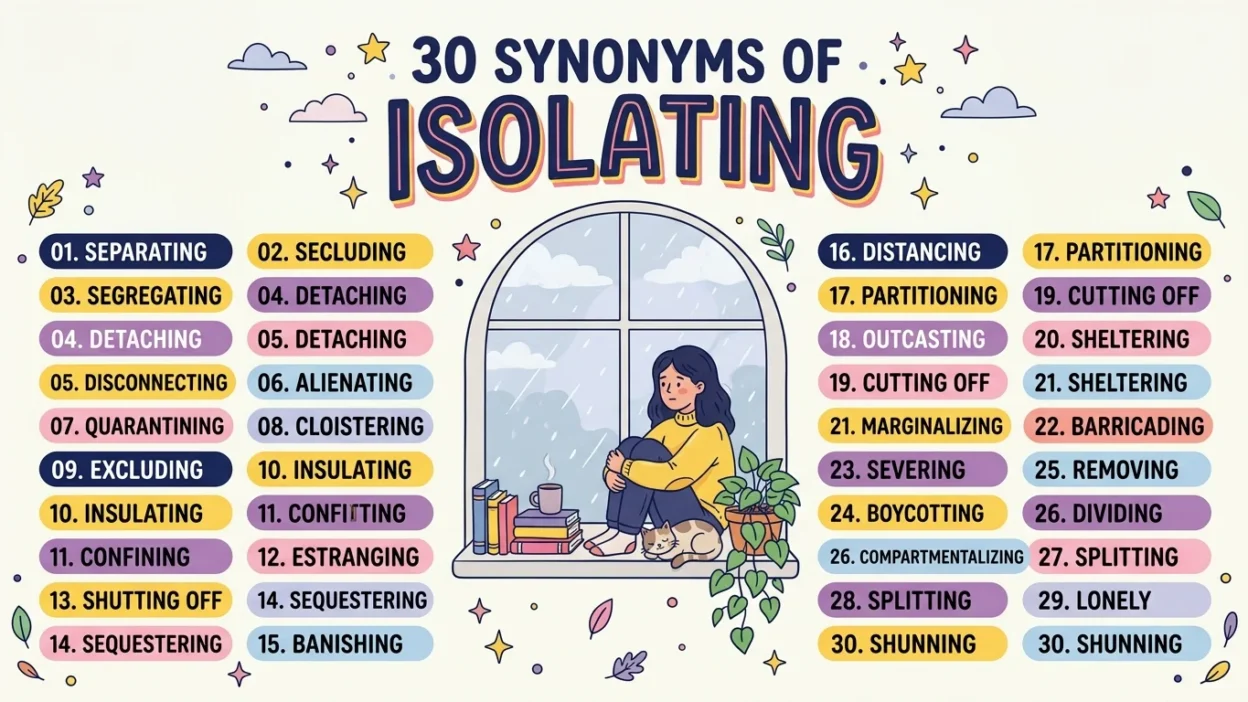
The synonyms of isolating include separating, disconnecting, segregating, distancing, detaching, excluding, alienating, and secluding. The best synonym depends on the context. For example, separating describes keeping things apart, secluding means keeping someone away from others, and alienating refers to making someone feel distant or unwelcome. Understanding these differences helps students, English learners, writers, and content creators choose the most accurate word for everyday conversations, academic writing, and professional communication.
Quick Answer: What Are the Synonyms of Isolating?
Here are 30 useful synonyms of isolating:
- Separating
- Disconnecting
- Segregating
- Detaching
- Secluding
- Excluding
- Alienating
- Distancing
- Dividing
- Partitioning
- Disengaging
- Disassociating
- Withdrawing
- Cutting off
- Sequestering
- Confning
- Segregating
- Disuniting
- Disjoining
- Disentangling
- Quarantining
- Screening off
- Setting apart
- Keeping apart
- Sidelining
- Marginalizing
- Ostracizing
- Insulating
- Sealing off
- Independently separating
Some words are close synonyms, while others apply only to specific situations. For example, quarantining is associated with preventing the spread of disease, whereas marginalizing describes treating a person or group as less important.
What Does Isolating Mean?
Isolating is the present participle of the verb isolate. It means separating a person, object, group, or thing from others, or making it independent from its surroundings.
The word can describe physical separation, social exclusion, emotional distance, or scientific processes.
Simple Definition
In simple English, isolating means keeping something or someone apart from others.
Examples:
- The researchers are isolating the bacteria for testing.
- Working from home sometimes feels isolating.
- The technician is isolating the faulty electrical circuit.
- The policy is isolating the community from essential services.
Different Uses of Isolating
1. Physical isolation: Keeping something physically separate.
Example: The workers are isolating the damaged section of the building.
2. Social isolation: Separating people from social contact or relationships.
Example: His behavior is isolating him from his friends.
3. Emotional isolation: Creating a feeling of loneliness or disconnection.
Example: Living far from family can feel isolating.
4. Scientific isolation: Separating a substance, organism, or variable for study.
Example: Scientists are isolating a specific compound from the sample.
5. Technical isolation: Separating a system, component, or circuit to prevent interference or danger.
Example: The electrician is isolating the power supply before making repairs.
30 Synonyms of Isolating With Meanings and Examples
The following words offer different ways to express the meaning of isolating. Each includes a simple definition, an example sentence, and guidance on when to use it.
1. Separating
Meaning: Keeping two or more things apart.
Example: The teacher is separating the students into smaller groups.
Best usage/context: Use separating for general physical, organizational, or conceptual division. It is one of the most versatile alternatives to isolating.
2. Disconnecting
Meaning: Breaking a physical, electronic, or figurative connection.
Example: Disconnecting the machine from the power supply makes maintenance safer.
Best usage/context: Use this word for cables, devices, systems, relationships, or situations where a connection is removed.
3. Segregating
Meaning: Separating people or things into different groups.
Example: The laboratory is segregating hazardous materials from ordinary waste.
Best usage/context: Use segregating when items or groups are deliberately classified or kept apart. When referring to people, the word can carry a serious historical or discriminatory meaning.
4. Detaching
Meaning: Removing something from what it is connected to.
Example: The engineer is detaching the damaged component from the main unit.
Best usage/context: Best for physical objects, components, and emotional distance. It often suggests removing a connection rather than simply creating space.
5. Secluding
Meaning: Keeping someone away from other people or outside activities.
Example: The writer spent the weekend secluding herself to finish her novel.
Best usage/context: Use secluding when someone stays away from others, often for privacy, peace, or protection.
6. Excluding
Meaning: Leaving someone or something out.
Example: The committee is excluding incomplete applications from the final review.
Best usage/context: Best for membership, participation, selection, and access. It emphasizes being left out rather than merely being apart.
7. Alienating
Meaning: Making someone feel distant, unwelcome, or disconnected.
Example: His harsh comments are alienating his closest colleagues.
Best usage/context: Use alienating for emotional distance, damaged relationships, or actions that cause people to lose trust or connection.
8. Distancing
Meaning: Creating space between people, objects, or ideas.
Example: She is distancing herself from the ongoing argument.
Best usage/context: Appropriate for physical space, emotional boundaries, professional relationships, and deliberate withdrawal from a situation.
9. Dividing
Meaning: Splitting something into separate parts or groups.
Example: The manager is dividing the team into two working groups.
Best usage/context: Use dividing for tasks, groups, territories, resources, or objects that need to be split into parts.
10. Partitioning
Meaning: Dividing an area, system, or collection into distinct sections.
Example: The designer is partitioning the office into private workspaces.
Best usage/context: Common in architecture, computing, data management, and technical writing. It often suggests a structured or clearly defined separation.
11. Disengaging
Meaning: Ending involvement or releasing a connection.
Example: He is disengaging from the discussion to avoid further conflict.
Best usage/context: Use this word for stepping away from an activity, relationship, mechanism, or commitment.
12. Disassociating
Meaning: Separating oneself or something from a person, group, idea, or connection.
Example: The company is disassociating its brand from the controversial campaign.
Best usage/context: Suitable for formal writing when someone wants to show that they are no longer connected with an idea, action, or organization.
Note: Disassociating and dissociating can overlap, but their preferred uses depend on context. Dissociating is especially common in psychology and technical terminology.
13. Withdrawing
Meaning: Moving away from participation, contact, or involvement.
Example: She is withdrawing from social activities while preparing for her exams.
Best usage/context: Use withdrawing when someone steps back from people, activities, commitments, or situations.
14. Cutting Off
Meaning: Stopping contact, communication, access, or supply.
Example: He is cutting off communication with people who repeatedly disrespect him.
Best usage/context: Best for everyday language about ending contact, blocking access, or stopping a connection. It is more direct and conversational than isolating.
15. Sequestering
Meaning: Keeping someone or something separate, often for privacy, security, or legal reasons.
Example: The court is sequestering the jury during the trial.
Best usage/context: Use sequestering in formal, legal, scientific, or specialized contexts involving controlled separation.
16. Confining
Meaning: Restricting someone or something to a limited space or area.
Example: The facility is confining the animals in a secure enclosure during treatment.
Best usage/context: Appropriate when isolation involves restricted movement or limited space. It often suggests a lack of freedom.
17. Disuniting
Meaning: Causing people or groups to lose their unity.
Example: The disagreement is disuniting a team that once worked well together.
Best usage/context: Use disuniting when focusing on the breakdown of cooperation, agreement, or togetherness. It is less common than dividing or separating.
18. Disjoining
Meaning: Separating things that are joined together.
Example: The technician is disjoining the two sections of the pipe.
Best usage/context: Best for connected objects, parts, structures, or concepts. It is relatively formal and less common in everyday speech.
19. Disentangling
Meaning: Separating things that are tangled or complicated.
Example: The researcher is disentangling the effects of income and education on the results.
Best usage/context: Use this word for tangled objects, complicated relationships, or ideas that need to be separated and understood individually.
20. Quarantining
Meaning: Separating people, animals, or items to prevent possible disease transmission or contamination.
Example: The team is quarantining the affected animals as a precaution.
Best usage/context: Appropriate for public health, veterinary care, laboratory safety, and certain cybersecurity situations involving suspicious files or systems.
21. Screening Off
Meaning: Blocking something from view, access, or direct contact.
Example: The builders are screening off the construction area from the public.
Best usage/context: Use this phrase when barriers, partitions, or protective measures separate an area from its surroundings.
22. Setting Apart
Meaning: Separating something from the rest or distinguishing it as special.
Example: The teacher is setting apart the advanced reading materials for experienced students.
Best usage/context: Useful when something is physically separated or deliberately distinguished from other things. It can also express uniqueness or importance.
23. Keeping Apart
Meaning: Preventing people or things from coming together.
Example: The organizers are keeping the two groups apart during the event.
Best usage/context: Use this simple phrase when describing deliberate separation, especially when people or objects must remain at a distance.
24. Sidelining
Meaning: Preventing someone or something from participating fully.
Example: The new policy is sidelining junior employees during important decisions.
Best usage/context: Best for workplace, political, sports, and social situations in which a person or group receives less attention or involvement.
25. Marginalizing
Meaning: Treating a person or group as less important or giving them less influence.
Example: The decision is marginalizing smaller communities in the planning process.
Best usage/context: Use marginalizing when the separation involves unequal treatment, reduced opportunities, or exclusion from power and participation.
26. Ostracizing
Meaning: Deliberately rejecting or excluding someone from a social group.
Example: The classmates are ostracizing a student because of a misunderstanding.
Best usage/context: Appropriate for social rejection, bullying, and group dynamics. It is stronger than ordinary separation because it emphasizes deliberate rejection.
27. Insulating
Meaning: Protecting or separating something from outside influences.
Example: The engineers are insulating the sensitive equipment from electrical interference.
Best usage/context: Use insulating in construction, electrical engineering, soundproofing, and figurative descriptions of protection from pressure or influence.
28. Sealing Off
Meaning: Closing an area or passage to prevent entry, exit, or movement.
Example: Emergency workers are sealing off the damaged section of the road.
Best usage/context: Best for restricted areas, dangerous locations, buildings, roads, and spaces that must be isolated for safety.
29. Detaching Oneself
Meaning: Creating emotional or personal distance from a situation.
Example: She is detaching herself from the conflict so she can think clearly.
Best usage/context: Use this expression when the focus is on a person’s decision to reduce emotional involvement or avoid becoming caught up in a difficult situation.
30. Segregating From
Meaning: Deliberately keeping a person, group, or thing separate from another.
Example: The procedure involves segregating the contaminated samples from the clean materials.
Best usage/context: Use this construction when the separation is between clearly identified groups or categories. In many sentences, separating from is a simpler and more natural alternative.
Comparison Table: Which Synonym of Isolating Should You Use?
The best word depends on what kind of separation you want to describe.
| Synonym | Main meaning | Best context | Tone |
|---|---|---|---|
| Separating | Keeping apart | General use | Neutral |
| Disconnecting | Breaking a connection | Technology and relationships | Neutral |
| Segregating | Dividing into groups | Materials and social groups | Formal or sensitive |
| Detaching | Removing a connection | Objects and emotions | Neutral |
| Secluding | Keeping away from others | Privacy and solitude | Neutral |
| Excluding | Leaving out | Membership and participation | Direct |
| Alienating | Creating emotional distance | Relationships | Negative |
| Distancing | Creating space | Personal boundaries | Neutral |
| Partitioning | Creating distinct sections | Design and computing | Technical |
| Withdrawing | Stepping away | Social or professional involvement | Neutral |
| Quarantining | Separating to prevent spread | Health and safety | Technical |
| Confining | Restricting movement | Restricted spaces | Strong |
| Sidelining | Limiting participation | Workplace and sports | Negative |
| Marginalizing | Reducing influence or importance | Social inequality | Critical |
| Ostracizing | Rejecting a person | Social exclusion | Strongly negative |
| Insulating | Protecting from outside effects | Engineering and protection | Technical |
| Sequestering | Keeping separately | Legal and formal settings | Formal |
| Sealing off | Blocking access | Safety and security | Direct |
Isolating vs. Similar Words: Important Differences
Although many synonyms of isolating overlap, they are not always interchangeable.
Isolating vs. Separating
Isolating often emphasizes making something independent or keeping it apart from its surroundings. Separating is a broader term for dividing things.
- Isolating: The scientist is isolating the active ingredient.
- Separating: The worker is separating the ingredients into different containers.
Isolating vs. Excluding
Isolating means keeping apart, while excluding means leaving someone or something out of a group, activity, or opportunity.
- Isolating: The person is becoming isolated from the community.
- Excluding: The group is excluding the person from its activities.
Isolating vs. Alienating
Isolating can describe physical or social separation. Alienating emphasizes a loss of emotional connection or a feeling of being unwelcome.
- Isolating: Working alone is isolating him from his colleagues.
- Alienating: His rude behavior is alienating his colleagues.
Isolating vs. Secluding
Secluding usually suggests keeping someone away from others, sometimes by choice. Isolating is broader and can involve people, objects, systems, or scientific processes.
- Secluding: She is secluding herself to concentrate.
- Isolating: The team is isolating the sample for testing.
Isolating vs. Marginalizing
Isolating emphasizes separation, whereas marginalizing emphasizes reduced importance, influence, or participation.
- Isolating: The policy is isolating the group from the wider community.
- Marginalizing: The policy is marginalizing the group by limiting its influence.
How to Choose the Right Synonym for Isolating
Choosing the right synonym becomes easier when you identify the purpose, tone, and setting of your sentence.
1. Choose According to Meaning
For physical separation:
- Separating
- Dividing
- Detaching
- Partitioning
- Keeping apart
Example: The technician is separating the damaged wires from the working components.
For emotional or social distance:
- Alienating
- Distancing
- Withdrawing
- Secluding
- Ostracizing
Example: Constant criticism is alienating her from her friends.
For exclusion from a group:
- Excluding
- Sidelining
- Marginalizing
- Ostracizing
Example: The decision is excluding local residents from the consultation process.
For technical or scientific contexts:
- Isolating
- Quarantining
- Insulating
- Partitioning
- Sequestering
Example: The researchers are isolating the compound for further analysis.
2. Choose According to Tone
Neutral tone: Separating, dividing, detaching, distancing.
Use these words when you want to describe separation without suggesting blame or harm.
Formal tone: Sequestering, partitioning, segregating, disassociating.
These words can suit academic, legal, professional, or technical writing, depending on the context.
Negative or critical tone: Alienating, excluding, marginalizing, ostracizing.
Choose these words when the sentence describes rejection, social harm, or reduced participation.
Protective tone: Insulating, quarantining, sealing off.
These words are useful when separation is intended to prevent danger, interference, or contamination.
3. Choose According to Your Intent
Ask yourself what you want the reader to understand.
- Do you mean keeping things apart? Choose separating.
- Do you mean breaking a connection? Choose disconnecting.
- Do you mean making someone feel unwanted? Choose alienating.
- Do you mean leaving someone out? Choose excluding.
- Do you mean protecting something from outside influences? Choose insulating.
- Do you mean restricting movement? Choose confining.
- Do you mean separating a sample for scientific study? Choose isolating.
- Do you mean deliberately rejecting someone socially? Choose ostracizing.
4. Choose According to Your Audience
For beginner English learners, simple words such as separating, dividing, and keeping apart are usually easiest to understand.
For academic writing, words such as partitioning, disassociating, and marginalizing may be more precise when their meanings fit.
For creative writing, alienating, secluding, and withdrawing can communicate emotional distance or loneliness more clearly.
Common Mistakes When Using Synonyms of Isolating
Mistake 1: Treating Every Synonym as an Exact Replacement
Not every synonym works in every sentence.
Incorrect: The scientist is ostracizing the chemical sample.
Better: The scientist is isolating the chemical sample.
Ostracizing normally refers to socially rejecting a person, while isolating is appropriate for a scientific sample.
Mistake 2: Confusing Isolation With Exclusion
Isolation means being separated or kept apart. Exclusion means being left out of a group, activity, or opportunity.
Example: A person may work alone by choice without being excluded by colleagues.
Mistake 3: Using Alienating When You Mean Physical Separation
Alienating generally emphasizes emotional distance or loss of connection.
Less suitable: The worker is alienating the two metal pieces.
Better: The worker is separating the two metal pieces.
Mistake 4: Using Confining Without Considering Restricted Freedom
Confining suggests that movement or freedom is limited. It may sound too strong if you simply mean keeping two objects apart.
Example: The staff are confining the patient to a room.
This sentence implies a restriction on movement, not just ordinary separation.
Mistake 5: Overusing Formal Vocabulary
Long or technical words do not automatically make writing better. Choose the simplest word that communicates your intended meaning accurately.
Instead of: The manager is disuniting the employees into separate operational categories.
Prefer: The manager is dividing the employees into separate teams.
Mistake 6: Confusing Isolating With Being Isolated
Isolating describes the act or process of separating something. Isolated often describes the resulting condition.
- Isolating: The technician is isolating the circuit.
- Isolated: The circuit is isolated from the power supply.
The correct form depends on the sentence structure and intended meaning.
FAQS:
1. What is the closest synonym of isolating?
Separating is one of the closest general synonyms of isolating. However, disconnecting, secluding, or detaching may be more suitable when the sentence concerns a specific type of separation.
2. What are five common synonyms of isolating?
Five common synonyms are separating, disconnecting, detaching, distancing, and excluding. Their meanings differ slightly, so choose the word that best matches your sentence.
3. What is another word for isolating someone socially?
Depending on the context, you can use excluding, alienating, ostracizing, marginalizing, or secluding. Use ostracizing when someone is deliberately rejected by a group and alienating when actions create emotional distance.
4. What is the opposite of isolating?
Common antonyms include connecting, joining, integrating, uniting, including, and bringing together.
For example, “The program is isolating students” can have the opposite meaning of “The program is connecting students.”
5. Is separating the same as isolating?
Not exactly. Both words involve keeping things apart, but isolating often emphasizes independence from surrounding influences or contact. Separating is a broader word that simply describes dividing things.
6. What is a formal synonym for isolating?
Depending on the context, formal alternatives include sequestering, partitioning, segregating, and disassociating. In scientific writing, however, isolating itself may be the most accurate and natural choice.
7. What is a synonym for isolating in science?
Separating, extracting, and purifying can be suitable alternatives in scientific contexts, but they are not exact synonyms in every situation. Isolating is often best when researchers separate a particular organism, substance, or variable for examination.
8. What does isolating mean in a sentence?
In a sentence, isolating usually means separating something or someone from others. For example, “The researchers are isolating the bacteria” means they are separating the bacteria so they can study them.
Conclusion
The synonyms of isolating offer different ways to describe separation, disconnection, exclusion, emotional distance, and protection. Words such as separating, detaching, and dividing work well for general situations, while alienating, ostracizing, and marginalizing describe social or emotional separation. In technical settings, partitioning, insulating, and quarantining may be more appropriate.
The key is to understand the meaning and tone of each word before using it. Whether you are writing an essay, improving your vocabulary, preparing for an English exam, or creating educational content, choosing the right synonym makes your communication clearer, more natural, and more precise.
Important editorial note: The list above contains 30 entries, but segregating appears twice in the original quick-answer list, and the detailed list includes overlapping expressions such as detaching oneself and segregating from. For a polished published article, replace the duplicate segregating in the quick answer with extracting, and consider using extracting as a distinct scientific alternative in the detailed list where appropriate.

Nathan Noah is a modern author known for his work at Synonym Loft, where he creates clear, helpful synonym-based content designed to improve vocabulary, writing skills, and language understanding online.


