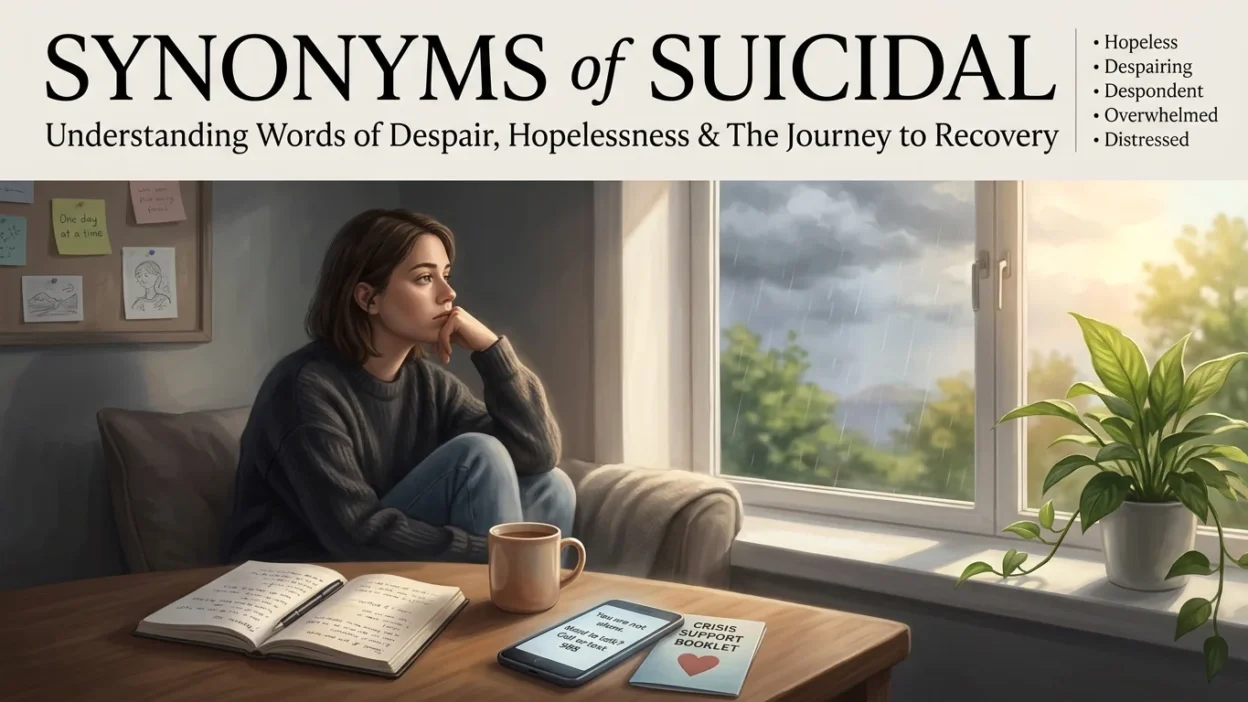
The word suicidal describes thoughts, feelings, actions, or situations connected with suicide or a serious risk of self-harm. It can also be used informally to describe extremely dangerous or reckless decisions. Understanding its meaning and related words helps students, ESL learners, writers, and content creators communicate clearly, accurately, and sensitively.
The best synonym depends on the context. Words such as self-destructive, reckless, and life-threatening may communicate related ideas, but they do not have exactly the same meaning as suicidal. Choosing the right word is especially important when discussing mental health.
Quick Answer: What Are the Synonyms of Suicidal?
Some related words and expressions include self-destructive, self-harming, life-threatening, dangerous, reckless, high-risk, despairing, hopeless, distressed, and crisis-related.
However, these words are not all direct synonyms. Some describe dangerous behavior, others describe emotional distress, and some refer to situations involving a risk to life. In mental health contexts, suicidal is often the most accurate term.
Meaning and Usage of Suicidal
What does suicidal mean?
Suicidal is an adjective that generally refers to having thoughts about suicide, being at risk of suicide, or relating to suicide. In informal speech, it can also describe behavior that exposes someone to extreme danger.
Examples:
- Mental health: “He told his counselor that he was experiencing suicidal thoughts.”
- Risky behavior: “Driving at high speed on an icy road was a suicidal decision.”
The second example uses the word figuratively. It does not mean that the driver necessarily intended to die.
When should you use a synonym for suicidal?
Choose a related word according to the meaning you want to express:
- For dangerous behavior: reckless, hazardous, or self-destructive.
- For emotional suffering: distressed, despairing, or hopeless.
- For danger to life: life-threatening or potentially fatal.
- For mental health discussions: suicidal thoughts, suicide risk, or suicide-related distress, depending on the facts.
Avoid using emotional distress and suicidal thoughts as if they were interchangeable. A person can experience sadness or hopelessness without having suicidal thoughts.
30 Synonyms and Related Words for Suicidal
The following list includes direct contextual alternatives, related expressions, and words that may be useful in writing. Each entry explains when the word is appropriate.
1. Self-destructive
Meaning: Harmful to one’s own well-being, future, or interests.
Example: “His self-destructive habits began to affect his relationships.”
Best usage: Describing harmful patterns, decisions, or behaviors. It does not necessarily imply suicidal intent.
2. Self-harming
Meaning: Involving intentional injury to oneself.
Example: “The counselor helped her find support for self-harming behavior.”
Best usage: Mental health discussions involving self-injury. Self-harm and suicidal behavior are distinct, although they can sometimes overlap.
3. Life-threatening
Meaning: Capable of causing death.
Example: “The patient received immediate treatment for a life-threatening injury.”
Best usage: Medical emergencies, severe injuries, and situations involving a serious threat to life.
4. Dangerous
Meaning: Likely to cause harm or injury.
Example: “Walking across the damaged bridge was dangerous.”
Best usage: General risks and unsafe situations.
5. Reckless
Meaning: Acting without sufficient care for possible consequences.
Example: “His reckless driving put everyone on the road at risk.”
Best usage: Risky decisions and behavior. It does not necessarily indicate a desire to die.
6. Hazardous
Meaning: Involving a significant risk of harm.
Example: “Working without protective equipment can be hazardous.”
Best usage: Workplace safety, environmental dangers, and other risky conditions.
7. High-risk
Meaning: Involving a greater-than-usual possibility of harm or an adverse outcome.
Example: “The patient required additional support because of a high-risk situation.”
Best usage: Clinical, professional, and safety-related writing. Specify the risk when possible.
8. Potentially fatal
Meaning: Capable of causing death.
Example: “The untreated condition could become potentially fatal.”
Best usage: Medical and safety contexts where the possibility of death is relevant.
9. Fatal
Meaning: Causing death or resulting in death.
Example: “The accident caused a fatal injury.”
Best usage: Describing an outcome or a danger that results in death. It is not a synonym for suicidal intent.
10. Self-endangering
Meaning: Putting oneself at risk of harm.
Example: “The rescue worker avoided self-endangering actions during the emergency.”
Best usage: Describing behavior that places a person in danger.
11. Despairing
Meaning: Feeling or expressing a loss of hope.
Example: “She sounded despairing after receiving the disappointing news.”
Best usage: Literature, emotional descriptions, and discussions of severe distress.
12. Hopeless
Meaning: Feeling that improvement or success is unlikely or impossible.
Example: “He felt hopeless about his situation but eventually reached out for help.”
Best usage: Describing a person’s feelings or outlook. Hopelessness alone does not establish suicidal intent.
13. Distressed
Meaning: Experiencing significant emotional pain, worry, or upset.
Example: “The distressed student spoke privately with a trusted teacher.”
Best usage: Mental health, personal difficulties, and emotionally challenging situations.
14. Despondent
Meaning: Very discouraged or low in spirits.
Example: “She became despondent after several unsuccessful attempts.”
Best usage: Formal writing and descriptions of deep discouragement.
15. Depressed
Meaning: Feeling very low or, in a clinical context, experiencing depression.
Example: “He felt depressed and decided to speak with a mental health professional.”
Best usage: Emotional descriptions or appropriate clinical discussions. Do not assume that depression automatically means a person is suicidal.
16. Agonized
Meaning: Experiencing intense emotional or physical suffering.
Example: “The agonized character struggled to make a difficult decision.”
Best usage: Literary writing and descriptions of intense suffering.
17. Troubled
Meaning: Experiencing worry, difficulty, or emotional problems.
Example: “The troubled teenager found comfort in talking with a trusted adult.”
Best usage: General descriptions of people facing personal difficulties.
18. Vulnerable
Meaning: Susceptible to harm or needing protection and support.
Example: “The vulnerable patient received additional emotional support.”
Best usage: Healthcare, social care, and discussions about a person’s circumstances. Vulnerability does not automatically indicate suicide risk.
19. Crisis-related
Meaning: Connected with a serious or urgent situation.
Example: “The organization provided crisis-related support to people experiencing emotional distress.”
Best usage: Mental health services, emergency assistance, and support programs.
20. Suicide-related
Meaning: Connected with suicide, suicidal thoughts, or suicide prevention.
Example: “The training covered suicide-related warning signs and appropriate responses.”
Best usage: Clear, factual writing about suicide prevention, mental health, and public health.
21. Suicidal-minded
Meaning: Having thoughts or a mindset associated with suicide.
Example: “The historical text described a character as suicidal-minded.”
Best usage: Rare or dated wording. In contemporary writing, experiencing suicidal thoughts is generally clearer and more natural.
22. Self-destructive-minded
Meaning: Inclined toward thoughts or choices that harm one’s own interests.
Example: “The novel portrays a self-destructive-minded character who repeatedly rejects support.”
Best usage: Literary analysis or descriptions of recurring harmful choices. This is not a standard clinical term.
23. Death-seeking
Meaning: Appearing to pursue or desire death.
Example: “The report examined the character’s death-seeking behavior within the fictional narrative.”
Best usage: Specialized, literary, or analytical contexts. Use cautiously because it can imply intent that has not been established.
24. Risk-taking
Meaning: Willing to engage in activities with uncertain or potentially harmful outcomes.
Example: “His risk-taking behavior worried his family.”
Best usage: Describing choices that involve risk. Risk-taking can be harmless or beneficial in some circumstances and is not inherently suicidal.
25. Impulsive
Meaning: Acting suddenly without carefully considering the consequences.
Example: “An impulsive decision created an avoidable problem.”
Best usage: Behavior and decision-making. Impulsivity alone does not indicate suicidal intent.
26. Irresponsible
Meaning: Failing to consider duties, consequences, or other people’s safety.
Example: “Leaving the equipment unsecured was irresponsible.”
Best usage: Criticizing unsafe or careless conduct. Avoid using blame-oriented language when discussing mental health struggles.
27. Unsafe
Meaning: Not protected from harm or danger.
Example: “The unsafe conditions required immediate attention.”
Best usage: General safety discussions and situations involving possible injury.
28. Perilous
Meaning: Extremely dangerous.
Example: “The climbers faced a perilous journey through the storm.”
Best usage: Formal, descriptive, or literary writing.
29. Precarious
Meaning: Unstable, uncertain, or potentially dangerous.
Example: “The patient was in a precarious condition and needed close monitoring.”
Best usage: Describing unstable situations, uncertain circumstances, or fragile conditions.
30. Self-jeopardizing
Meaning: Placing oneself in danger or jeopardizing one’s own interests.
Example: “Ignoring the safety instructions was self-jeopardizing.”
Best usage: Formal or explanatory writing about actions that expose someone to risk. It is less common than self-endangering.
Comparison Table: Which Synonym Fits Best?
| Word or phrase | Main meaning | Best context |
|---|---|---|
| Suicidal | Related to suicide or suicidal thoughts | Mental health and suicide risk |
| Self-destructive | Harmful to oneself or one’s interests | Habits and behavior |
| Self-harming | Involving intentional self-injury | Mental health discussions |
| Reckless | Ignoring serious risks | Decisions and actions |
| Life-threatening | Capable of causing death | Medical and safety contexts |
| Hopeless | Feeling that improvement is impossible | Emotional descriptions |
| Despairing | Feeling a profound loss of hope | Formal and literary writing |
| Distressed | Experiencing emotional suffering | Personal and mental health contexts |
| High-risk | Involving an elevated risk | Clinical and professional writing |
| Perilous | Extremely dangerous | Descriptive and literary writing |
Important distinction: The words in this table overlap in some situations, but they are not interchangeable in every sentence. If a person has expressed suicidal thoughts, replacing suicidal with reckless, depressed, or dangerous may change the meaning.
How to Choose the Right Synonym for Suicidal
1. Choose according to tone
- Neutral and professional: suicide-related, high-risk, life-threatening.
- Emotional: despairing, hopeless, distressed.
- Descriptive or literary: perilous, agonized, despondent.
- Behavior-focused: self-destructive, reckless, impulsive.
Use the least judgmental word that accurately communicates the intended meaning.
2. Choose according to meaning
If you are describing thoughts about suicide, use suicidal thoughts or suicidal ideation when appropriate.
If you are describing behavior that causes harm to oneself, self-destructive may fit.
If you mean that a situation could result in death, use life-threatening or potentially fatal.
If you are describing intense sadness or discouragement, despairing, despondent, or hopeless may be more precise.
3. Choose according to intent
Ask yourself what the sentence needs to communicate:
- Thoughts or intentions: Use wording that explicitly refers to suicidal thoughts or intent when supported by the facts.
- Actions that create danger: Consider reckless, unsafe, or self-endangering.
- Emotional suffering: Consider distressed, despairing, or troubled.
- A serious medical danger: Consider life-threatening or potentially fatal.
Never infer suicidal intent merely because someone takes risks, experiences depression, or behaves impulsively.
Common Mistakes When Using Synonyms of Suicidal
Mistake 1: Treating all related words as exact synonyms
Hopeless, reckless, and life-threatening describe different things. None automatically means that a person is suicidal.
Better approach: Choose a word that expresses the precise meaning of the original sentence.
Mistake 2: Confusing self-harm with suicide attempts
Self-harm refers to intentional self-injury, which may occur with or without suicidal intent. A suicide attempt involves at least some intent to die.
Better approach: Describe the behavior accurately without assuming the person’s intentions.
Mistake 3: Using suicidal as a casual exaggeration
Calling every risky activity “suicidal” can minimize the seriousness of suicidal thoughts and behavior.
Better approach: Use reckless, extremely dangerous, or high-risk when you mean that an activity is unsafe rather than suicide-related.
Mistake 4: Assuming sadness means suicidal thoughts
A person may be sad, depressed, or discouraged without experiencing suicidal thoughts.
Better approach: Distinguish emotional symptoms from thoughts, intentions, and behaviors.
Mistake 5: Using outdated or unnatural expressions
Terms such as suicidal-minded are uncommon in contemporary English.
Better approach: Prefer natural expressions such as “experiencing suicidal thoughts” or “at risk of suicide,” depending on the context.
FAQS:
1. What is the closest synonym for suicidal?
There is no single synonym that fits every context. Suicide-related may work in general descriptions, while experiencing suicidal thoughts is more precise when referring to a person’s thoughts.
2. What is another word for suicidal behavior?
The best alternative depends on the behavior. Self-destructive behavior describes actions harmful to oneself, while suicidal behavior should be retained when suicide-related intent or actions are specifically meant.
3. Is self-destructive the same as suicidal?
No. Self-destructive behavior can harm a person’s health, relationships, or future without any intention to die. Suicidal refers specifically to suicide or suicide-related thoughts, intent, or risk.
4. Is hopeless a synonym for suicidal?
Not exactly. Hopeless describes a feeling that circumstances cannot improve. Although hopelessness can occur alongside suicidal thoughts, the words have different meanings.
5. What is a formal word for suicidal?
In clinical or professional writing, suicidal ideation is a formal term for thoughts about suicide. Suicide-related is useful for broader topics, but it is not an exact replacement in every sentence.
6. What is a synonym for suicidal when describing dangerous actions?
Depending on the sentence, reckless, self-endangering, self-destructive, or life-threatening may fit. Use suicidal only when the intended meaning genuinely relates to suicide.
7. Can suicidal and self-harming be used interchangeably?
No. Self-harming describes intentional self-injury, while suicidal refers to suicide-related thoughts, intentions, or behaviors. The terms can overlap, but one should not be assumed from the other.
Conclusion
Learning the synonyms of suicidal helps writers express danger, emotional distress, harmful behavior, and suicide-related concerns more accurately. Words such as self-destructive, reckless, hopeless, distressed, and life-threatening can be useful alternatives when their meanings match the context.
The most important rule is to prioritize accuracy and sensitivity. When writing about mental health, use direct and respectful language, avoid unsupported assumptions about a person’s intentions, and distinguish emotional distress from suicidal thoughts. Choosing the right word makes your writing clearer, more natural, and more considerate of readers.