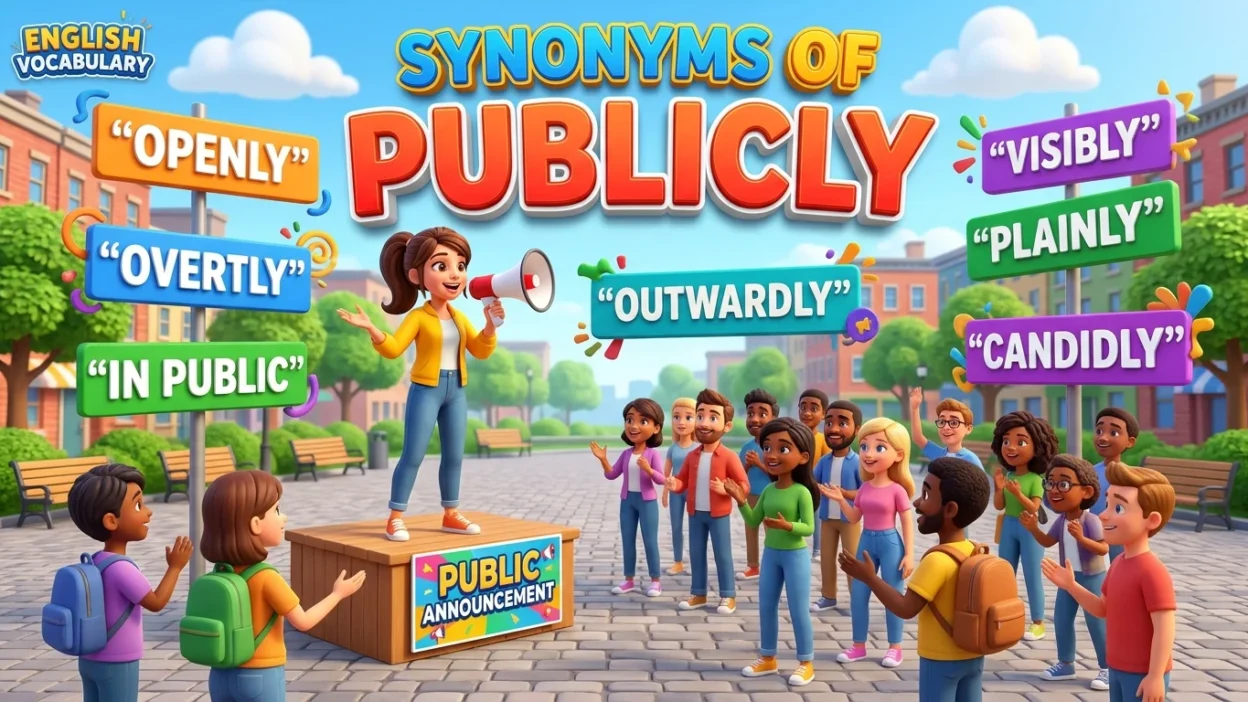
The word “publicly” means doing, saying, sharing, or making something known in a way that other people can see, hear, or access. Common synonyms of publicly include openly, openly in public, officially, openly acknowledged, publicly, visibly, and in front of others, depending on the context.
Choosing the right synonym for publicly can make your writing clearer and more natural. For example, openly emphasizes honesty, officially suggests formal recognition, and in public describes something happening where other people can witness it.
In this guide, you will discover 30 synonyms of publicly, their simple meanings, example sentences, and the situations where each word or phrase works best.
Quick Answer: What Are the Best Synonyms of Publicly?
The best synonyms of publicly include:
Openly, in public, publicly, visibly, openly acknowledged, officially, overtly, transparently, outwardly, openly declared, before an audience, in front of others, in the open, on record, publicly announced, openly expressed, collectively, openly shared, publicly available, and without secrecy.
The most suitable choice depends on what you want to communicate. Use openly for something done without hiding it, officially for formal announcements, and in public for actions witnessed by other people.
Meaning and Usage of Publicly
What Does Publicly Mean?
Publicly is an adverb that describes an action performed openly, communicated to the public, or made available for others to see or know.
It can describe speech, behavior, announcements, opinions, information, and official decisions.
Examples:
- The company publicly announced its new policy.
- She openly expressed her concerns during the meeting.
- The athlete apologized publicly for the mistake.
- The documents are publicly available online.
When Should You Use Publicly?
Use publicly when you want to emphasize that something is not private or hidden.
The word is especially useful in news articles, professional writing, academic discussions, workplace communication, and everyday conversations.
For example, “The mayor publicly supported the proposal” means the mayor expressed support in a way that other people could know about.
However, publicly does not always mean officially. A person can publicly share a personal opinion without making an official statement.
30 Synonyms of Publicly With Meanings and Examples
The following words and phrases are related to publicly, but they are not interchangeable in every situation. Choose the one that best matches your intended meaning.
1. Openly
Simple meaning: Without hiding your thoughts, feelings, or actions.
Example: She openly discussed her concerns with her colleagues.
Best usage/context: Use openly when emphasizing honesty, directness, or a lack of secrecy.
2. In Public
Simple meaning: In a place where other people can see or hear you.
Example: He apologized to his friend in public.
Best usage/context: Best for describing actions that happen in public places or before other people.
3. Officially
Simple meaning: In a formal or authorized way.
Example: The organization officially announced the results yesterday.
Best usage/context: Use officially for formal announcements, decisions, approvals, and declarations.
4. Overtly
Simple meaning: In a clear, noticeable, and unmistakable way.
Example: The manager overtly criticized the proposed changes.
Best usage/context: Suitable for formal writing when an action or attitude is clearly expressed rather than concealed.
5. Transparently
Simple meaning: In an open way that allows others to understand what is happening.
Example: The committee transparently explained how the funds were distributed.
Best usage/context: Use transparently when discussing honesty, accountability, processes, or decision-making.
6. Visibly
Simple meaning: In a way that can be seen.
Example: The announcement visibly changed the mood of the audience.
Best usage/context: Appropriate when the emphasis is on something observable or apparent. It is not always a direct replacement for publicly.
7. Outwardly
Simple meaning: In a way that appears on the outside.
Example: He outwardly accepted the decision, although he remained disappointed.
Best usage/context: Use outwardly when describing visible behavior or appearances that may differ from private feelings.
8. In the Open
Simple meaning: In a place or situation where something is not hidden.
Example: The disagreement was discussed in the open.
Best usage/context: Useful for discussions about transparency, honesty, and bringing hidden issues into view.
9. Before an Audience
Simple meaning: In front of a group of people watching or listening.
Example: She confidently presented her research before an audience.
Best usage/context: Best for speeches, performances, presentations, and public events.
10. In Front of Others
Simple meaning: Where other people can witness an action.
Example: He thanked his teacher in front of others.
Best usage/context: Suitable for everyday conversations about actions witnessed by other people.
11. Publicly Announced
Simple meaning: Officially or openly communicated to a group or the general public.
Example: The winners were publicly announced on Friday.
Best usage/context: Use this phrase for results, decisions, events, policies, and important news.
12. Openly Declared
Simple meaning: Clearly stated or announced without concealment.
Example: The candidate openly declared her support for the new policy.
Best usage/context: Suitable for political statements, personal positions, and clear declarations.
13. Publicly Expressed
Simple meaning: Communicated so that other people can hear, see, or know it.
Example: Several employees publicly expressed their concerns.
Best usage/context: Use it for opinions, feelings, concerns, beliefs, and reactions.
14. Openly Expressed
Simple meaning: Communicated honestly and without hiding feelings or opinions.
Example: He openly expressed his disagreement with the proposal.
Best usage/context: Particularly useful when the focus is on honesty and direct communication.
15. Without Secrecy
Simple meaning: In a way that is not concealed or kept private.
Example: The negotiations proceeded without secrecy.
Best usage/context: Use this phrase when emphasizing the absence of concealment.
16. On Record
Simple meaning: Formally stated or documented so that it can be referred to later.
Example: The spokesperson went on record supporting the decision.
Best usage/context: Common in journalism, interviews, official statements, and professional discussions. It does not simply mean that something happened in public.
17. Publicly Available
Simple meaning: Accessible to the public rather than restricted to private individuals.
Example: The research report is publicly available on the university’s website.
Best usage/context: Best for documents, reports, records, datasets, and online resources.
18. Widely Known
Simple meaning: Known by many people.
Example: It is widely known that the town has a rich cultural history.
Best usage/context: Use widely known when describing information familiar to many people, rather than the act of making an announcement.
19. Broadly Communicated
Simple meaning: Shared with a large group or a wide audience.
Example: The updated guidelines were broadly communicated to employees.
Best usage/context: Appropriate for workplace announcements, organizational messages, and information distribution.
20. Openly Shared
Simple meaning: Shared without hiding or restricting the information unnecessarily.
Example: The team openly shared its findings with other researchers.
Best usage/context: Useful for collaborative work, personal experiences, research, and discussions.
21. Publicly Disclosed
Simple meaning: Made information known to people outside a private or restricted group.
Example: The organization publicly disclosed its annual financial results.
Best usage/context: Best for formal disclosures involving finances, investigations, policies, or important information.
22. Unreservedly
Simple meaning: Without holding back or expressing reservations.
Example: She unreservedly praised the team’s outstanding performance.
Best usage/context: Use it when emphasizing wholehearted support, praise, agreement, or acceptance. It does not necessarily mean in front of the public.
23. Frankly
Simple meaning: Honestly and directly.
Example: He frankly explained why he disagreed with the proposal.
Best usage/context: Best for candid communication and direct expression, particularly in conversations and discussions.
24. Candidly
Simple meaning: Honestly and openly, without hiding important thoughts or feelings.
Example: The director candidly discussed the challenges facing the organization.
Best usage/context: Suitable for interviews, serious discussions, professional communication, and personal reflections.
25. Conspicuously
Simple meaning: In a way that is easily noticed.
Example: The company conspicuously displayed its new environmental policy.
Best usage/context: Use conspicuously when emphasizing visibility or prominence, not necessarily public communication.
26. Evidently
Simple meaning: In a way that appears clear from available evidence.
Example: The new policy evidently attracted considerable public attention.
Best usage/context: Appropriate for drawing conclusions from observable facts. It is not a direct synonym for publicly in most sentences.
27. Collectively
Simple meaning: Together as a group.
Example: The employees collectively voiced their concerns at the meeting.
Best usage/context: Use collectively when emphasizing group action or shared responsibility. It describes how people act together, not whether an action is public.
28. In Plain Sight
Simple meaning: In a place where something can easily be seen.
Example: The notice was posted in plain sight near the entrance.
Best usage/context: Useful when emphasizing visibility or the fact that something is not hidden.
29. Publicly Recognized
Simple meaning: Acknowledged or appreciated openly by other people or an organization.
Example: Her contribution was publicly recognized during the ceremony.
Best usage/context: Best for awards, achievements, professional contributions, and formal acknowledgment.
30. Before the Public
Simple meaning: In front of members of the public or through communication intended for them.
Example: The official defended the decision before the public.
Best usage/context: Appropriate for formal writing about public speeches, accountability, and visible leadership.
Comparison Table: Publicly vs. Similar Words
| Synonym | Main meaning | Best context |
|---|---|---|
| Openly | Without concealment | Feelings and opinions |
| In public | Where others can witness it | Actions and behavior |
| Officially | In a formal or authorized way | Announcements and decisions |
| Overtly | Clearly and noticeably | Attitudes and actions |
| Transparently | Openly and accountably | Processes and decisions |
| Visibly | In a way that can be seen | Observable changes |
| Candidly | Honestly and directly | Conversations and interviews |
| Frankly | Directly and honestly | Opinions and discussions |
| On record | Formally stated or documented | Journalism and formal statements |
| Publicly disclosed | Made known to the public | Reports and important information |
| Widely known | Familiar to many people | Established facts |
| Collectively | Together as a group | Group decisions and actions |
Which Synonym Fits Your Sentence?
Consider these examples:
- Original: The company publicly announced the results.
- Formal: The company officially announced the results.
- Transparent: The company openly shared the results.
- Informational: The results were made publicly available.
- Accountability-focused: The company transparently explained the results.
Each sentence emphasizes a slightly different idea. The best choice depends on whether you want to highlight a formal announcement, openness, access to information, or accountability.
How to Choose the Right Synonym for Publicly
1. Choose According to Tone
Your choice of synonym can make a sentence sound conversational, professional, or formal.
For everyday English:
- In public
- Openly
- In front of others
For professional writing:
- Transparently
- Officially
- Publicly disclosed
- On record
For formal or academic writing:
- Overtly
- Publicly expressed
- Broadly communicated
Example:
Casual: “She talked openly about the problem.”
Formal: “She publicly addressed the problem.”
The second version emphasizes addressing an issue before an audience or making a public statement.
2. Choose According to Meaning
Different synonyms highlight different aspects of public communication.
To emphasize honesty:
- Openly
- Candidly
- Frankly
To emphasize visibility:
- Visibly
- Conspicuously
- In plain sight
To emphasize formal communication:
- Officially
- Publicly announced
- On record
To emphasize access to information:
- Publicly available
- Publicly disclosed
- Openly shared
Example:
“The report was publicly available” means people could access it.
“The report was publicly announced” means its existence or contents were communicated to an audience.
These statements are related but not identical.
3. Choose According to Intent
Ask yourself what you want your sentence to communicate.
- Making an announcement: Use officially or publicly announced.
- Sharing an opinion: Use openly expressed or publicly expressed.
- Admitting a mistake: Use openly acknowledged or publicly acknowledged.
- Showing accountability: Use transparently.
- Speaking honestly: Use candidly or frankly.
- Describing a public setting: Use in public or before an audience.
- Making information accessible: Use publicly available.
Choosing a synonym according to intent helps avoid awkward sentences and preserves your original meaning.
Common Mistakes When Using Synonyms of Publicly
Mistake 1: Treating Openly and Officially as Identical
Incorrect assumption: Openly and officially always mean the same thing.
Correct understanding: Openly means without concealment, while officially means through a formal or authorized process.
Example:
- “She openly supported the proposal.” — She expressed her support without hiding it.
- “She officially supported the proposal.” — Her support was formally expressed or recognized.
Mistake 2: Confusing Publicly With Widely Known
Something can be widely known without being deliberately announced.
Example:
“The town’s history is widely known.”
This describes how familiar the history is to people, not how it was communicated.
Mistake 3: Using Visibly When You Mean Publicly
Visibly refers to something that can be seen. Publicly usually concerns public access, exposure, or communication.
Example:
- “He visibly reacted to the news.” — His reaction could be seen.
- “He publicly reacted to the news.” — He reacted in a public setting or in a way that reached the public.
Mistake 4: Using Candidly as a Direct Replacement in Every Sentence
Candidly emphasizes honesty, not necessarily the presence of an audience.
Example:
“She candidly explained her concerns during a private meeting.”
The explanation can be candid even though it is not public.
Mistake 5: Ignoring Grammar and Sentence Structure
Some synonyms are single adverbs, while others are phrases that need different sentence structures.
Example:
- “The decision was publicly announced.”
- “The decision was announced before an audience.”
- “The decision was made publicly available.”
Do not replace a word without checking whether the revised sentence remains grammatically correct.
FAQS:
1. What is the closest synonym of publicly?
Openly is one of the closest synonyms when publicly means doing or communicating something without hiding it. However, in public is more appropriate when the emphasis is on being seen or heard by other people.
2. What are five common synonyms of publicly?
Five common alternatives are openly, in public, officially, overtly, and transparently. Each has a slightly different meaning and works best in particular contexts.
3. What is a formal synonym for publicly?
Officially, publicly disclosed, transparently, and on record can work in formal writing. Choose the word that matches the intended meaning rather than using a formal-sounding term automatically.
4. What is another word for publicly announced?
Possible alternatives include officially announced, openly declared, publicly disclosed, and formally announced. The best choice depends on whether the announcement is official, open, or intended to disclose information.
5. What is the difference between publicly and openly?
Publicly emphasizes public exposure, communication, or accessibility. Openly emphasizes the absence of concealment and can describe honest communication even in a private conversation.
6. Can publicly and officially be used interchangeably?
Not always. A statement can be made publicly without being official, and an official decision may be communicated privately before it is released to the public.
7. What is the opposite of publicly?
Common opposites include privately, secretly, confidentially, discreetly, and behind closed doors. The best antonym depends on the sentence. For example, privately contrasts with a public setting, while secretly emphasizes concealment.
8. How can I use publicly in an academic sentence?
Use publicly when discussing statements, research findings, announcements, or information accessible to a broad audience.
Example: “The researchers publicly presented their findings at an international conference.”
For a more specific meaning, use openly to emphasize transparency or officially to emphasize formal recognition.
Conclusion
Learning synonyms of publicly helps you express ideas more clearly and choose words that fit different situations. While openly, in public, officially, overtly, and transparently are useful alternatives, they do not all communicate exactly the same meaning.
Use openly when you want to emphasize honesty, in public when describing an action witnessed by others, officially for formal announcements, and transparently when highlighting accountability.
The key is to consider the meaning, tone, audience, and purpose of your sentence before choosing a replacement. With practice, you can use these 30 synonyms to make your English more precise, natural, and effective.
Would you like a 20-word meta description or 10 alternative H1 titles for this article?

Harper Ava is the administrator of SynonymLoft, a language-focused platform dedicated to synonyms, vocabulary improvement, and writing support, helping users enhance English language skills and expand word knowledge effectively.