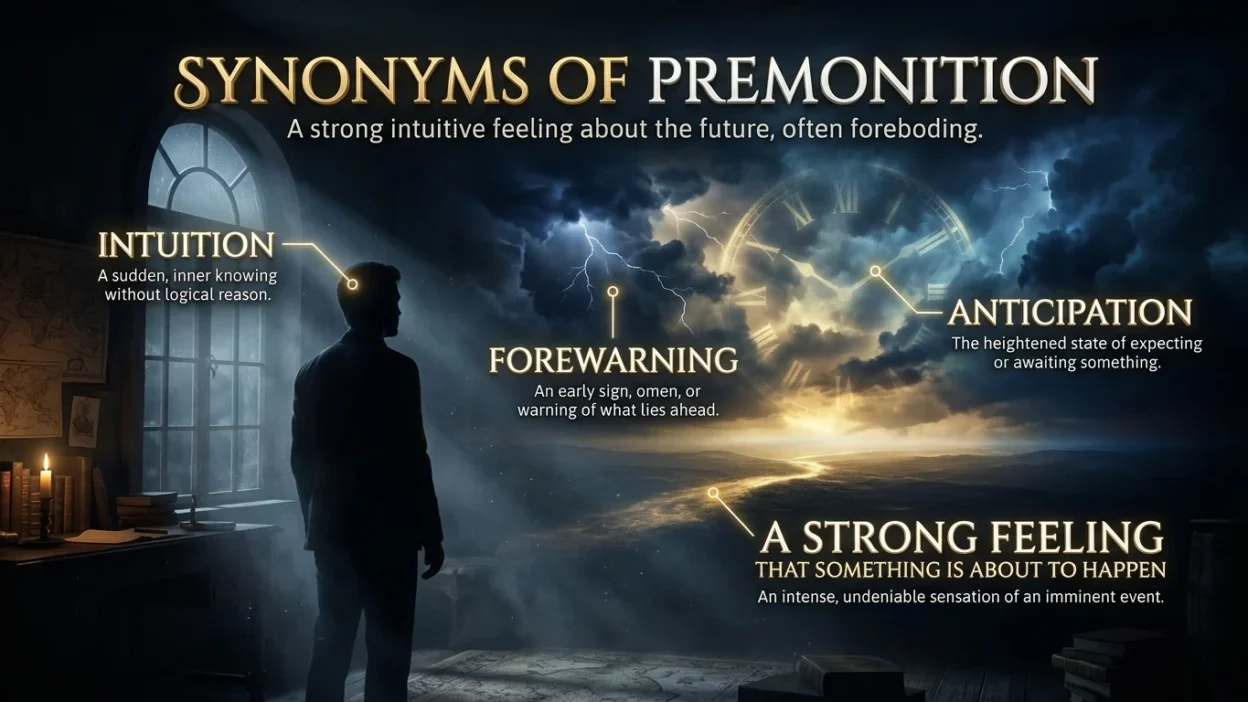
Have you ever had a strong feeling that something was going to happen before it actually occurred? That mysterious feeling is called a premonition. It describes an impression, warning, or sense that an event may happen in the future, even when there is no clear evidence to support it.
Understanding synonyms of premonition can help you express predictions, intuitions, warnings, and unexplained feelings more accurately. Words such as foreboding, presentiment, intuition, anticipation, and prediction are closely related, but each has a slightly different meaning.
Whether you are a student, ESL learner, writer, or content creator, learning these alternatives will help you improve your vocabulary and communicate your ideas more clearly.
Quick Answer: What Are the Synonyms of Premonition?
The best synonyms of premonition include:
- Foreboding
- Presentiment
- Intuition
- Hunch
- Prediction
- Warning
- Omen
- Feeling
- Anticipation
- Suspicion
- Presage
- Forewarning
- Foresight
- Inference
- Insight
These words describe a feeling, thought, sign, or expectation that something may happen in the future. The best alternative depends on whether you want to express a mysterious feeling, a negative expectation, or a reasoned prediction.
What Does Premonition Mean?
A premonition is a strong feeling or impression that something is going to happen in the future, especially when there is no obvious reason for believing it will happen.
In simple English, it means feeling that something is about to happen before you know it for certain.
Examples:
- She had a strange premonition that something bad would happen.
- His premonition about the unexpected meeting turned out to be correct.
- I experienced a sudden premonition before receiving the phone call.
Different Uses of Premonition
Premonition can be used in several situations:
- Negative expectations: A feeling that something unpleasant or dangerous may happen.
- Positive expectations: A feeling that something good may happen.
- Intuitive feelings: An unexplained sense about a future event.
- Literary descriptions: A mysterious feeling that creates suspense in stories and novels.
30 Best Synonyms of Premonition With Meanings and Examples
Below are 30 useful alternatives to premonition, including their meanings, example sentences, and the situations where they work best.
1. Foreboding
Simple meaning: A feeling that something bad is going to happen.
Example: She experienced a sense of foreboding before entering the abandoned building.
Best usage/context: Use foreboding when describing an uneasy or frightening expectation about the future.
2. Presentiment
Simple meaning: A feeling that something is going to happen before it occurs.
Example: He had a presentiment that his journey would bring unexpected changes.
Best usage/context: Suitable for formal writing, literature, and descriptions of unexplained feelings.
3. Intuition
Simple meaning: The ability to understand or sense something without conscious reasoning.
Example: My intuition told me that something was wrong.
Best usage/context: Use intuition when someone senses something naturally without needing clear evidence.
4. Hunch
Simple meaning: A feeling or belief that something is true or likely to happen.
Example: I had a hunch that she would arrive earlier than expected.
Best usage/context: Best for informal conversations and everyday situations.
5. Prediction
Simple meaning: A statement about what may happen in the future.
Example: His prediction about the upcoming competition proved accurate.
Best usage/context: Use prediction when discussing an expected future event based on information, knowledge, or judgment.
6. Warning
Simple meaning: A sign or message that alerts someone to possible danger.
Example: The sudden silence felt like a warning of approaching trouble.
Best usage/context: Appropriate when a premonition suggests danger or something unpleasant.
7. Omen
Simple meaning: An event or sign believed to indicate something that will happen.
Example: The dark clouds were considered an omen of difficult times.
Best usage/context: Use omen in symbolic, traditional, mysterious, or literary contexts.
8. Anticipation
Simple meaning: The feeling of expecting something to happen.
Example: She waited in anticipation of the important announcement.
Best usage/context: Suitable for expressing excitement, expectation, or nervousness about future events.
9. Suspicion
Simple meaning: A feeling that something may be true, often without complete proof.
Example: He had a suspicion that the meeting would not go as planned.
Best usage/context: Use suspicion when the feeling involves doubt or uncertainty.
10. Presage
Simple meaning: A sign or indication of something that will happen in the future.
Example: The unusual weather seemed to presage a difficult winter.
Best usage/context: Best for formal, literary, and descriptive writing.
11. Forewarning
Simple meaning: An advance notice or indication of possible trouble.
Example: The strange noise gave us a forewarning of the approaching storm.
Best usage/context: Use when someone receives an early indication of a future problem.
12. Foresight
Simple meaning: The ability to think ahead and understand what may happen.
Example: Her foresight helped the company avoid serious problems.
Best usage/context: Appropriate for planning, leadership, decision-making, and future preparation.
13. Insight
Simple meaning: A clear understanding of something.
Example: He had an unusual insight into how the situation would develop.
Best usage/context: Use when a person’s understanding or judgment helps them recognize what may happen.
14. Premonitory Feeling
Simple meaning: A feeling that something is likely to happen before it occurs.
Example: She experienced a premonitory feeling before hearing the unexpected news.
Best usage/context: Useful in formal descriptions and psychological or literary discussions.
15. Gut Feeling
Simple meaning: A strong feeling about something without knowing exactly why.
Example: My gut feeling told me not to trust the offer.
Best usage/context: Best for casual conversations and personal experiences.
16. Apprehension
Simple meaning: Anxiety or worry about something that may happen.
Example: He entered the examination hall with apprehension about the difficult test.
Best usage/context: Use when a future possibility creates nervousness or concern.
17. Portent
Simple meaning: A sign that something important, often unpleasant, is going to happen.
Example: The sudden disappearance of the birds seemed like a portent of disaster.
Best usage/context: Suitable for dramatic writing, storytelling, and formal descriptions.
18. Prophecy
Simple meaning: A statement claiming to reveal what will happen in the future.
Example: The ancient prophecy described the arrival of a powerful leader.
Best usage/context: Use in religious, historical, mythical, or fictional contexts.
19. Forecast
Simple meaning: An estimate of what is likely to happen.
Example: The economic forecast suggested a period of slow growth.
Best usage/context: Best for weather, business, economics, and evidence-based expectations.
20. Expectation
Simple meaning: A belief that something will happen.
Example: She had an expectation that the journey would be successful.
Best usage/context: Use for general beliefs or assumptions about future events.
21. Conviction
Simple meaning: A strong belief that something is true.
Example: He had a strong conviction that everything would eventually work out.
Best usage/context: Appropriate when expressing confidence in a belief or expected outcome.
22. Intimation
Simple meaning: An indirect suggestion or indication of something.
Example: There was an intimation that major changes were coming.
Best usage/context: Useful in formal writing when describing a subtle hint about future developments.
23. Premise
Simple meaning: An idea or statement used as the basis for reasoning.
Example: Her argument rested on the premise that the situation would soon change.
Best usage/context: Use in logical, academic, or argumentative writing. It is not a direct synonym for premonition.
24. Indication
Simple meaning: A sign or piece of information suggesting something.
Example: The sudden drop in temperature was an indication of approaching winter.
Best usage/context: Appropriate when there is some observable evidence of a future event.
25. Sign
Simple meaning: Something that suggests or shows that an event may happen.
Example: The unusual behavior was a sign that something was wrong.
Best usage/context: Use in everyday conversations and simple descriptions.
26. Portending
Simple meaning: Suggesting that something is likely to happen.
Example: The growing tension was portending a serious disagreement.
Best usage/context: Suitable for descriptive and literary writing.
27. Hunching
Simple meaning: Having a suspicion or intuitive feeling about something.
Example: I was hunching that the surprise would be revealed before evening.
Best usage/context: This is not a natural standard substitute for premonition as a noun. Prefer having a hunch in everyday English.
28. Clairvoyance
Simple meaning: An alleged ability to know about events beyond normal senses.
Example: The character claimed to have clairvoyance and predict distant events.
Best usage/context: Use when discussing paranormal beliefs, supernatural stories, or alleged psychic abilities.
29. Divination
Simple meaning: The practice of trying to discover future events through supernatural or mystical methods.
Example: The ancient tradition included divination to understand possible future events.
Best usage/context: Appropriate for historical, cultural, mystical, and religious discussions.
30. Intimation of Trouble
Simple meaning: A subtle feeling or suggestion that something unpleasant may happen.
Example: His unusual silence gave her an intimation of trouble.
Best usage/context: Useful in literary and descriptive writing when creating a sense of approaching difficulty.
Comparison Table: Premonition and Its Closest Synonyms
Not every synonym of premonition communicates exactly the same idea. The following table explains the main differences.
| Synonym | Main meaning | Common tone |
|---|---|---|
| Foreboding | Feeling of approaching trouble | Negative |
| Presentiment | Unexplained feeling about the future | Formal |
| Intuition | Understanding without reasoning | Neutral |
| Hunch | Personal unexplained belief | Informal |
| Omen | Sign of a future event | Mysterious |
| Prediction | Statement about the future | Neutral |
| Apprehension | Worry about what may happen | Anxious |
| Presage | Sign of a future event | Literary |
| Prophecy | Claimed revelation of the future | Mystical |
| Foresight | Ability to anticipate outcomes | Positive |
| Forewarning | Advance notice of danger | Cautious |
| Anticipation | Expectation of something | Neutral |
Which Synonym Is Closest to Premonition?
- Presentiment: One of the closest alternatives because it describes an unexplained feeling about a future event.
- Foreboding: Best when the feeling involves possible danger or an unpleasant outcome.
- Hunch: Best for casual and everyday conversations.
- Intuition: Best when someone senses something without conscious reasoning.
- Omen: Best when an external sign is believed to indicate the future.
How to Choose the Right Synonym for Premonition
Choosing the correct synonym depends on your meaning, tone, and writing purpose.
1. Choose According to Tone
Different words create different impressions.
Formal tone:
- Presentiment
- Presage
- Intimation
- Forewarning
Informal tone:
- Hunch
- Gut feeling
- Feeling
- Suspicion
Literary or dramatic tone:
- Foreboding
- Omen
- Portent
- Prophecy
2. Choose According to Meaning
Think about what kind of feeling you want to describe.
- An unexplained feeling: Presentiment or intuition.
- A negative expectation: Foreboding or apprehension.
- A future prediction: Prediction or forecast.
- A mysterious sign: Omen or portent.
- An early warning: Forewarning or warning.
- A natural sense of understanding: Gut feeling or intuition.
3. Choose According to Intent
Your writing purpose also matters.
| Writing purpose | Recommended word |
|---|---|
| Academic writing | Prediction |
| Creative storytelling | Foreboding |
| Casual conversation | Hunch |
| Mysterious atmosphere | Omen |
| Professional planning | Foresight |
| Personal experience | Intuition |
| Expressing anxiety | Apprehension |
| Describing supernatural beliefs | Clairvoyance |
Common Mistakes When Using Premonition Synonyms
Some words are related to premonition but cannot always replace it. Here are common mistakes to avoid.
1. Confusing Premonition With Prediction
A premonition is usually an unexplained feeling about the future, while a prediction is a statement or judgment about what may happen.
Incorrect understanding: Every prediction is a premonition.
Correct understanding: A prediction may be based on facts, while a premonition may come from an unexplained feeling.
2. Using Foreboding for Positive Feelings
Foreboding generally describes an unpleasant or threatening expectation.
Example: She felt a sense of foreboding before the accident.
For a positive feeling, anticipation or intuition may be more suitable.
3. Confusing Omen With Intuition
An omen is usually an external sign believed to indicate the future. Intuition is an internal feeling or understanding.
Example:
- The black clouds were considered an omen.
- My intuition told me to wait.
4. Using Formal Words in Casual Conversations
Words such as presentiment, presage, and portent can sound overly formal in everyday speech.
Instead, use simpler alternatives such as hunch or gut feeling.
5. Treating Every Related Word as an Exact Synonym
Words such as foresight, prophecy, and divination are related to future knowledge, but their meanings are different.
Always consider the context before replacing premonition with another word.
(FAQs)
1. What is the closest synonym for premonition?
Presentiment is one of the closest synonyms because it describes a feeling or impression that something will happen before it occurs. Foreboding is another close alternative when the feeling is negative.
2. What is a simple word for premonition?
A simple word for premonition is hunch. It describes a feeling that something is true or likely to happen without having clear evidence.
3. What is another word for a bad premonition?
Common alternatives include foreboding, apprehension, ominous feeling, and presentiment. Foreboding is especially useful when describing a feeling that something unpleasant is approaching.
4. Is intuition the same as premonition?
No. Intuition is the ability to understand or sense something without conscious reasoning. Premonition specifically involves a feeling about a future event. However, intuition can sometimes create a premonition-like feeling.
5. What is the opposite of premonition?
There is no single perfect opposite of premonition. Depending on the context, words such as uncertainty, unawareness, surprise, or unpredictability may express contrasting ideas.
6. Can premonition be used in a positive sentence?
Yes. Premonition does not always describe something bad. It can also refer to an unexplained feeling that something good is going to happen.
Example: She had a premonition that her life was about to change for the better.
7. What is the difference between premonition and foreboding?
Premonition is a general feeling that something may happen in the future. Foreboding specifically describes an uneasy feeling that something bad or unpleasant is approaching.
8. What is the plural form of premonition?
The plural form is premonitions.
Example: He experienced several strange premonitions before the journey.
Conclusion
Learning synonyms of premonition helps you express feelings, expectations, warnings, and predictions with greater accuracy. Words such as presentiment, foreboding, intuition, hunch, omen, and presage are useful alternatives, but each carries a slightly different meaning and tone.
If you want to describe an unexplained feeling, use presentiment or intuition. For a negative expectation, choose foreboding. For everyday conversations, hunch is a simple and natural alternative.
The key is to understand the context before choosing a synonym. With these 30 alternatives and practical examples, you can make your English vocabulary richer, clearer, and more expressive.