Introduction
Understanding the synonyms of naivete can help you express innocence, inexperience, and a lack of knowledge more clearly. Whether you are a student, an English learner, a writer, or a content creator, choosing the right synonym makes your communication more accurate and natural.
Naivete refers to a lack of experience, wisdom, or awareness that may cause someone to trust others too easily or misunderstand a situation. Depending on the context, it can describe a positive quality, such as innocence, or a weakness, such as gullibility.
In this guide, you will discover 30 synonyms of naivete, their simple meanings, example sentences, and the situations in which each word works best.
Quick Answer: What Are the Synonyms of Naivete?
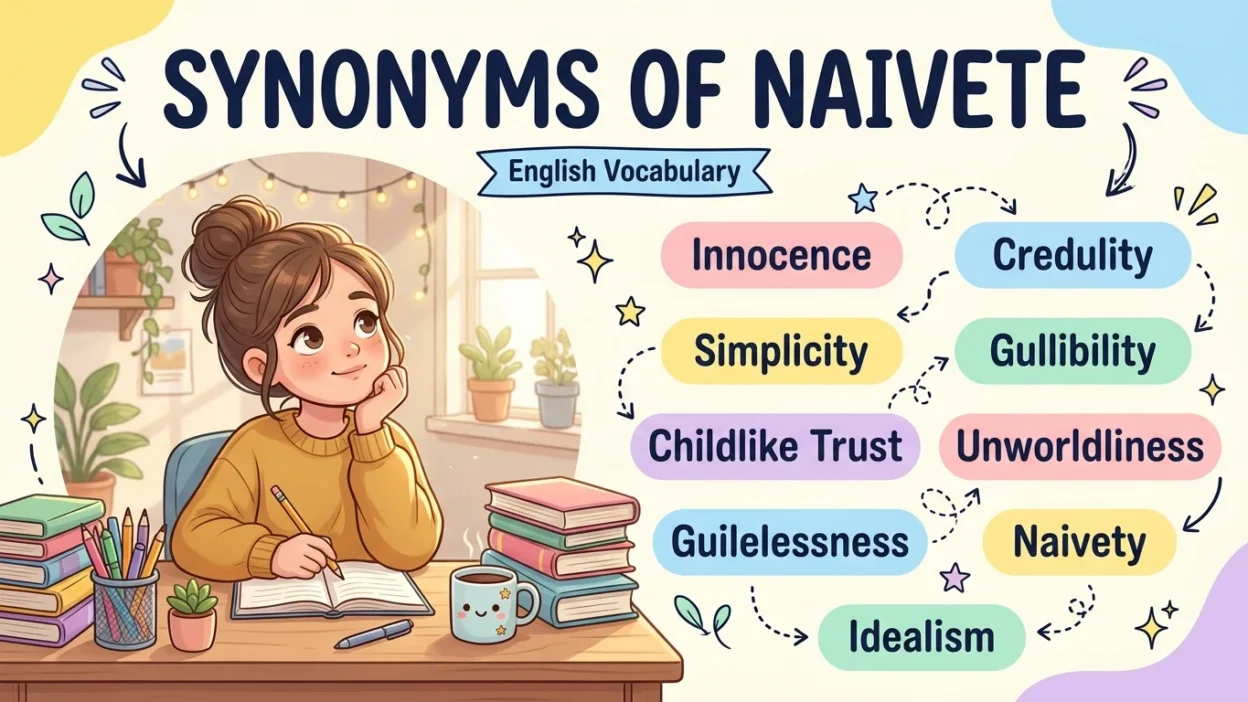
The most common synonyms of naivete are innocence, inexperience, simplicity, gullibility, credulity, artlessness, unsophistication, childlikeness, trustfulness, and ingenuousness.
Other related words include ignorance, greenhornism, openness, candor, sincerity, idealism, imprudence, and unsuspectingness. However, these words have slightly different meanings, so the best choice depends on the context.
What Does Naivete Mean?
Naivete (also spelled naivety) is a noun that describes a lack of experience, worldly knowledge, or understanding of how people and situations work.
A person showing naivete may believe others too easily, expect everything to be fair, or fail to recognize hidden risks.
Example: Her naivete led her to believe that every online offer was genuine.
In this sentence, naivete suggests that the person lacked the experience needed to recognize a possible scam.
Is Naivete Positive or Negative?
Naivete can have either a positive or negative meaning.
- Positive: It can suggest innocence, honesty, openness, or a lack of harmful intentions.
- Negative: It can suggest gullibility, poor judgment, or a lack of practical experience.
- Neutral: It can simply describe someone who is unfamiliar with a particular subject or situation.
For example, a child’s naivete may seem charming, while an adult’s naivete about financial risks may create problems.
30 Synonyms of Naivete With Meanings and Examples
The following words are useful alternatives to naivete. Some are close synonyms, while others describe related qualities that fit particular situations.
1. Innocence
Meaning: A lack of harmful intentions, guilt, or knowledge of unpleasant realities.
Example: Her innocence made her believe that everyone wanted to help.
Best usage: Use innocence when you want to emphasize purity, honesty, or a lack of wrongdoing.
2. Inexperience
Meaning: A lack of practical knowledge gained through doing something.
Example: His inexperience showed when he handled his first business negotiation.
Best usage: Use inexperience when someone is new to a job, activity, relationship, or situation.
3. Simplicity
Meaning: A straightforward or uncomplicated way of thinking or behaving.
Example: The simplicity of her view made the complicated problem seem easy.
Best usage: Use simplicity when describing an uncomplicated outlook. It does not always imply naivete.
4. Gullibility
Meaning: A tendency to believe things too easily, even when they may be false.
Example: His gullibility made him an easy target for online scammers.
Best usage: Use gullibility when someone is easily tricked or deceived.
5. Credulity
Meaning: A willingness to believe something without enough evidence.
Example: Her credulity led her to accept the unbelievable story without question.
Best usage: Use credulity in formal writing or when discussing how readily someone accepts claims.
6. Artlessness
Meaning: Natural honesty or a lack of calculated behavior.
Example: His artlessness made his answer sound sincere.
Best usage: Use artlessness when emphasizing natural behavior without manipulation or pretension.
7. Ingenuousness
Meaning: The quality of being innocent, sincere, and straightforward.
Example: Her ingenuousness was evident in the honest way she answered every question.
Best usage: Use ingenuousness when describing genuine sincerity or innocence, especially in formal writing.
8. Unsophistication
Meaning: A lack of experience or familiarity with complex social situations.
Example: His unsophistication was apparent during his first formal dinner.
Best usage: Use unsophistication when someone lacks worldly knowledge, social experience, or familiarity with a particular environment.
9. Trustfulness
Meaning: A tendency to trust other people.
Example: Her trustfulness encouraged her to give strangers the benefit of the doubt.
Best usage: Use trustfulness when emphasizing a trusting nature. It can be positive or negative depending on the situation.
10. Childlikeness
Meaning: A quality associated with a child’s openness, wonder, or innocence.
Example: His childlikeness made him excited about even the smallest discoveries.
Best usage: Use childlikeness to describe innocent curiosity or wonder, not necessarily a lack of intelligence.
11. Ignorance
Meaning: A lack of knowledge or information about something.
Example: Her ignorance of the contract terms caused unnecessary confusion.
Best usage: Use ignorance when the main issue is missing knowledge rather than excessive trust.
12. Simplicity of Mind
Meaning: A straightforward way of thinking that may lack awareness of complex issues.
Example: His simplicity of mind prevented him from noticing the hidden problems in the proposal.
Best usage: Use this phrase when describing an uncomplicated or insufficiently critical understanding. Be aware that it can sound judgmental.
13. Greenhornism
Meaning: The state of being inexperienced or new to a particular activity.
Example: His greenhornism was obvious during his first week on the construction site.
Best usage: Use this uncommon, informal term when discussing a beginner’s lack of experience. In everyday English, inexperience or being a greenhorn is more natural.
14. Unsuspectingness
Meaning: A state of not expecting deception, danger, or an unpleasant surprise.
Example: The stranger took advantage of her unsuspectingness.
Best usage: Use unsuspectingness when someone is unaware of a hidden threat. In natural writing, being unsuspecting is often preferable.
15. Naivety
Meaning: The same basic quality as naivete: a lack of experience or worldly understanding.
Example: His naivety about business expenses led to an unrealistic budget.
Best usage: Use naivety as a spelling variant of naivete. Both forms are accepted in English.
16. Openness
Meaning: A willingness to listen, share ideas, or accept new experiences.
Example: Her openness made it easy for colleagues to discuss their concerns.
Best usage: Use openness when emphasizing a receptive and honest attitude. Unlike naivete, openness does not necessarily imply poor judgment.
17. Candor
Meaning: The quality of speaking honestly and directly.
Example: His candor surprised the committee during the meeting.
Best usage: Use candor when focusing on honest communication rather than inexperience.
18. Sincerity
Meaning: The quality of being genuine and honest in feelings or intentions.
Example: Her sincerity convinced the audience that she truly cared about the issue.
Best usage: Use sincerity when emphasizing genuine feelings or intentions.
19. Idealism
Meaning: The belief that people and situations can achieve high or admirable standards.
Example: Her idealism led her to believe that cooperation could solve every disagreement.
Best usage: Use idealism when someone has hopeful beliefs that may overlook practical limitations.
20. Trustfulness of Nature
Meaning: A naturally trusting attitude toward other people.
Example: His trustfulness of nature made him quick to welcome new acquaintances.
Best usage: Use this descriptive phrase when discussing a person’s general tendency to trust others. The shorter word trustfulness is usually more concise.
21. Unworldliness
Meaning: A lack of practical knowledge about society and everyday realities.
Example: His unworldliness became clear when he struggled to recognize the dishonest sales pitch.
Best usage: Use unworldliness when someone lacks worldly experience or practical awareness.
22. Injudiciousness
Meaning: A lack of good judgment when making decisions.
Example: Her injudiciousness led her to invest money without checking the risks.
Best usage: Use injudiciousness when the focus is poor judgment rather than innocence.
23. Imprudence
Meaning: A failure to consider possible risks or consequences.
Example: His imprudence was clear when he shared confidential information with a stranger.
Best usage: Use imprudence when someone’s lack of caution leads to an unwise action.
24. Foolishness
Meaning: A lack of good sense or practical judgment.
Example: It was foolishness to trust an unfamiliar website with his banking details.
Best usage: Use foolishness when you want to criticize a decision or behavior. It is more negative than naivete.
25. Incredulity
Meaning: Difficulty believing something or a tendency to doubt a claim.
Example: She listened with incredulity when he described the extraordinary event.
Best usage: Use incredulity when someone finds a claim hard to believe. Important: It is generally the opposite of credulity, not a synonym of naivete.
26. Gullibility of Nature
Meaning: A general tendency to believe others without questioning their claims.
Example: His gullibility of nature made him vulnerable to exaggerated promises.
Best usage: Use this phrase only when a descriptive expression is needed. The single word gullibility is more natural and concise.
27. Injudicious Trust
Meaning: Trust that is given without enough thought or evidence.
Example: Her injudicious trust in the stranger resulted in a costly mistake.
Best usage: Use this phrase when the problem is trusting someone without evaluating the risks.
28. Innocence of Mind
Meaning: A mental outlook that is free from suspicion or awareness of harmful intentions.
Example: His innocence of mind made it difficult for him to imagine deliberate dishonesty.
Best usage: Use this phrase in descriptive or literary writing to emphasize an innocent outlook.
29. Inexperience of the World
Meaning: A lack of knowledge about practical life, social behavior, or people’s motives.
Example: Her inexperience of the world made the unfamiliar city seem friendlier than it really was.
Best usage: Use this phrase when you want to emphasize limited real-world experience. Lack of worldly experience is often more natural in everyday English.
30. Uncritical Trust
Meaning: Belief in someone or something without careful examination.
Example: His uncritical trust in online reviews led him to buy a poor-quality product.
Best usage: Use uncritical trust in discussions of misinformation, decision-making, research, and online safety.
Comparison Table: Which Synonym of Naivete Fits Best?
Different synonyms emphasize different aspects of naivete. This table can help you choose a word that fits your sentence.
| Synonym | Main meaning | Tone | Best context |
|---|---|---|---|
| Innocence | Lack of harmful intentions or worldly awareness | Positive or neutral | Children, character, intentions |
| Inexperience | Lack of practical knowledge | Neutral | Work, study, relationships |
| Gullibility | Easily deceived | Negative | Scams, false claims |
| Credulity | Readiness to believe claims | Formal, often negative | Essays, critical analysis |
| Artlessness | Natural, uncalculated behavior | Positive | Personality, conversation |
| Ingenuousness | Sincere and innocent behavior | Positive or formal | Literature, personal qualities |
| Unsophistication | Lack of worldly or social experience | Neutral or negative | Social settings, culture |
| Trustfulness | Tendency to trust others | Positive or neutral | Personality |
| Unworldliness | Lack of practical knowledge of life | Neutral or negative | Life experience |
| Idealism | Hopeful beliefs about what is possible | Positive or critical | Social issues, goals |
| Imprudence | Failure to consider risks | Negative | Decisions and actions |
| Ignorance | Lack of knowledge | Neutral or negative | Education, specific subjects |
| Candor | Honest, direct expression | Positive | Communication |
| Sincerity | Genuine feelings or intentions | Positive | Relationships, character |
| Foolishness | Poor sense or judgment | Negative | Mistakes and bad decisions |
How to Choose the Right Synonym of Naivete
The best synonym depends on what you want to communicate. Consider the person’s behavior, the situation, and the tone of your writing.
1. Choose According to Tone
Positive tone: Use innocence, artlessness, ingenuousness, or sincerity when you want to highlight honesty and genuine intentions.
Example: Her artlessness made her easy to approach.
Neutral tone: Use inexperience, lack of worldly knowledge, or unfamiliarity when you want to describe a person’s background without judging them.
Example: His inexperience with public speaking was understandable.
Negative tone: Use gullibility, credulity, imprudence, or foolishness when the sentence focuses on a mistake, poor judgment, or vulnerability to deception.
Example: Her gullibility made the fake advertisement seem convincing.
2. Choose According to Meaning
- Lack of experience: Inexperience, unsophistication, unworldliness.
- Excessive trust: Gullibility, credulity, trustfulness.
- Innocent character: Innocence, artlessness, ingenuousness.
- Lack of knowledge: Ignorance, unfamiliarity, lack of understanding.
- Poor judgment: Imprudence, injudiciousness, foolishness.
- Hopeful beliefs: Idealism, optimism, hopefulness.
- Honest communication: Candor, sincerity, openness.
These categories overlap, but each word directs attention to a different quality.
3. Choose According to Intent
If you are writing an academic essay, credulity or inexperience may be more appropriate than gullibility.
If you are writing a story, innocence, artlessness, or unworldliness can help describe a character’s personality.
If you are discussing online fraud, gullibility, uncritical trust, or imprudent trust can express the risk more precisely.
If you want to describe a beginner without criticizing them, inexperience is usually the safest choice.
Common Mistakes When Using Synonyms of Naivete
1. Treating Every Synonym as an Exact Match
Not all related words have the same meaning. For example, innocence concerns purity or lack of harmful intentions, while gullibility concerns believing things too easily.
Incorrect approach: Replacing naivete with any related word without considering the sentence.
Better approach: Identify whether the intended meaning is innocence, inexperience, excessive trust, or poor judgment.
2. Confusing Credulity With Incredulity
These words have opposite meanings in many contexts.
- Credulity: Readiness to believe something.
- Incredulity: Difficulty believing something.
Example: Her credulity made her accept the rumor, while his incredulity made him question it.
3. Using Ignorance When You Mean Inexperience
Ignorance refers to a lack of knowledge, whereas inexperience refers to a lack of practical experience.
Example: A new employee may have limited experience with a software program without being generally ignorant.
4. Using Innocence to Mean Poor Judgment
Innocence often has a positive meaning. If someone makes an unsafe decision because they trust a stranger too easily, gullibility or imprudence may be more accurate.
5. Choosing Uncommon Words in Everyday Conversation
Words such as ingenuousness and unsophistication can be useful, but they may sound formal. In everyday speech, inexperience, innocence, and gullibility are usually easier to understand.
6. Assuming Naivete Always Means Low Intelligence
Naivete does not automatically mean that someone is unintelligent. An intelligent person can lack experience in a particular area or trust someone because they have not encountered deception before.
FAQS:
1. What is the most common synonym of naivete?
Inexperience is one of the closest general alternatives when naivete means a lack of practical or worldly knowledge. Innocence is more suitable when the emphasis is on purity or a lack of harmful intentions, while gullibility fits situations involving excessive trust.
2. What are five synonyms of naivete?
Five useful synonyms or near-synonyms are innocence, inexperience, gullibility, credulity, and artlessness. Each emphasizes a slightly different quality.
3. Is naivete positive or negative?
Naivete can be positive, neutral, or negative. It may suggest innocence and sincerity, describe limited experience, or criticize a tendency to believe others too easily.
4. What is the difference between naivete and gullibility?
Naivete generally refers to a lack of experience or worldly understanding. Gullibility specifically means being too ready to believe something, making a person easier to deceive.
5. What is the difference between naivete and innocence?
Innocence often suggests purity, honesty, or an absence of harmful intentions. Naivete more directly suggests limited experience or awareness. A person can be innocent without being naive, and a naive person does not necessarily have innocent intentions.
6. What is the formal synonym of naivete?
Credulity, ingenuousness, and unsophistication can work in formal writing, depending on the intended meaning. Use credulity for excessive readiness to believe, ingenuousness for sincere innocence, and unsophistication for limited worldly experience.
7. Is naivety the same as naivete?
Yes. Both are accepted spellings of the noun. Naivety is common in British English, while naivete is widely used in American English. Usage varies, and either form is generally understood.
8. What is the opposite of naivete?
Possible opposites include worldliness, sophistication, experience, discernment, and skepticism. The best antonym depends on the intended meaning. For example, discernment is an opposite when naivete means poor judgment, while experience is suitable when it means a lack of practical knowledge.
Conclusion
Learning the synonyms of naivete helps you describe innocence, inexperience, trust, and judgment with greater accuracy. Although words such as innocence, inexperience, gullibility, and credulity are closely related, they are not interchangeable in every situation.
Choose innocence when you want to emphasize purity, inexperience when someone lacks practical knowledge, and gullibility when someone believes others too easily. For formal writing, credulity and ingenuousness may be useful choices.
The key is to consider the meaning, tone, and context of your sentence before selecting a synonym. This simple habit will help you write more naturally, communicate more clearly, and build a stronger English vocabulary.
Replace weak entries with true synonymsSeparate synonyms from related concepts

Harper Ava is the administrator of SynonymLoft, a language-focused platform dedicated to synonyms, vocabulary improvement, and writing support, helping users enhance English language skills and expand word knowledge effectively.