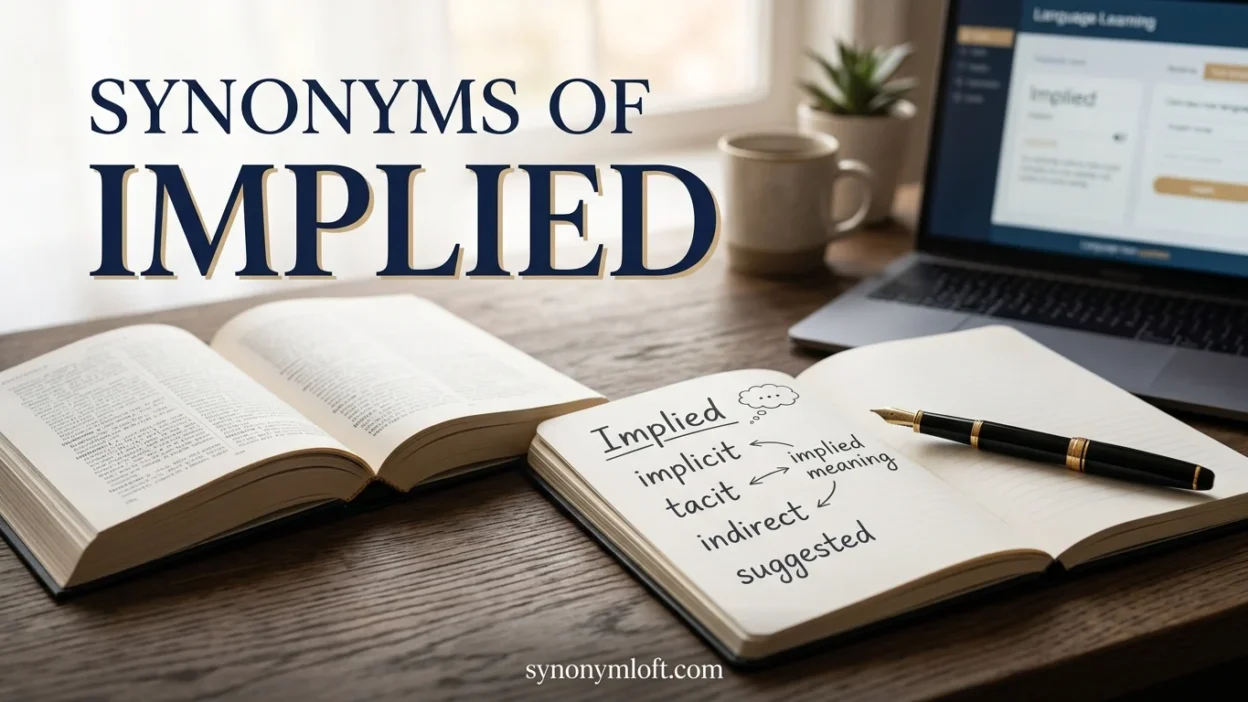
The best synonyms of implied include suggested, indirect, hinted, inferred, unstated, implicit, understood, and indicated. These words describe something that is communicated or understood without always being expressed directly.
However, each synonym has a slightly different meaning and works best in a particular context. Learning these differences can help students, ESL learners, writers, and content creators express ideas more clearly and naturally.
Quick Answer: What Are the Best Synonyms of Implied?
The most useful synonyms of implied are:
- Suggested — communicated as a possibility without stating it directly.
- Implicit — understood without being directly expressed.
- Hinted — communicated indirectly through a clue or remark.
- Inferred — understood from available facts or evidence.
- Indicated — pointed to or showed something.
- Unstated — not expressed in words.
- Indirect — communicated without saying something plainly.
- Intimated — suggested something subtly or indirectly.
- Understood — accepted or recognized without necessarily being stated.
- Insinuated — suggested something, often unpleasant, in an indirect way.
The right synonym depends on whether you want to describe a hidden meaning, an indirect statement, an unstated agreement, or a conclusion drawn from evidence.
What Does Implied Mean?
The word implied is the past tense and past participle of the verb imply. It describes something that is suggested, communicated, or understood without being stated clearly or directly.
When a person implies something, they allow the listener or reader to understand an idea through their words, actions, tone, or situation rather than expressing it openly.
Simple Definition
Implied means suggested or communicated indirectly rather than stated explicitly.
For example:
- Direct statement: “You are late again.”
- Implied meaning: The speaker may be suggesting that you are often late and should be more punctual.
The implied meaning depends on the situation and the speaker’s intention. It is not always the only possible interpretation.
Examples of Implied in Different Contexts
In everyday conversation:
“It’s getting late,” she said.
Implied meaning: She may want to leave or suggest that it is time to go home.
In literature:
The character smiled when she heard the news.
Implied meaning: The smile may suggest happiness, relief, or satisfaction, depending on the surrounding story.
In academic writing:
The research findings implied a possible connection between sleep and memory.
Meaning: The findings suggested a connection without necessarily proving it.
In legal or formal writing:
The agreement included certain implied obligations.
Meaning: Some obligations were understood to exist even though they were not expressly written into the agreement.
30 Synonyms of Implied With Meanings and Examples
The following 30 words and phrases are useful alternatives to implied. Each includes a simple meaning, an example sentence, and guidance on when to use it.
1. Suggested
Meaning: Presented an idea or possibility without stating it directly.
Example: Her expression suggested that she was disappointed.
Best usage: Use suggested in everyday conversation, academic writing, reports, and descriptive writing. It is one of the most natural alternatives to implied.
2. Implicit
Meaning: Understood or included without being directly expressed.
Example: There was an implicit agreement that everyone would help with the project.
Best usage: Use implicit in formal writing, academic discussions, professional communication, and descriptions of expectations or assumptions.
3. Indirect
Meaning: Communicated in a way that does not state the message plainly.
Example: His indirect response suggested that he did not support the proposal.
Best usage: Use indirect when describing communication, criticism, questions, answers, or messages that avoid being completely straightforward.
4. Hinted
Meaning: Gave a small clue about something without explaining it fully.
Example: She hinted that she had planned a surprise for the weekend.
Best usage: Use hinted in informal conversation, storytelling, dialogue, and situations involving clues or subtle suggestions.
5. Inferred
Meaning: Reached a conclusion based on facts, clues, or evidence.
Example: From his silence, I inferred that he disagreed with the decision.
Best usage: Use inferred in academic writing, reading comprehension, research, and analytical discussions. It focuses on the conclusion made by the reader or listener.
6. Indicated
Meaning: Showed, pointed to, or provided evidence of something.
Example: The results indicated that the new method was effective.
Best usage: Use indicated in reports, research papers, formal communication, and situations where evidence points toward a conclusion.
7. Unstated
Meaning: Not expressed openly in words.
Example: There was an unstated expectation that employees would arrive on time.
Best usage: Use unstated when emphasizing that something was not verbally or explicitly communicated.
8. Understood
Meaning: Recognized or accepted as the meaning of something, even if it was not directly stated.
Example: It was understood that everyone would contribute to the discussion.
Best usage: Use understood for shared expectations, agreements, instructions, and common knowledge.
9. Intimated
Meaning: Communicated something subtly or indirectly.
Example: The manager intimated that changes might be made to the schedule.
Best usage: Use intimated in formal or literary writing. It often describes a delicate or restrained suggestion.
10. Insinuated
Meaning: Suggested something indirectly, often something negative or questionable.
Example: He insinuated that his colleague had taken credit for someone else’s work.
Best usage: Use insinuated when a person indirectly suggests an accusation, criticism, or unpleasant possibility. It usually carries a negative tone.
11. Alluded To
Meaning: Referred to something indirectly without explaining it fully.
Example: The author alluded to a difficult childhood without giving specific details.
Best usage: Use alluded to in literary analysis, essays, speeches, and discussions where a person refers to an idea, event, or subject indirectly.
12. Conveyed
Meaning: Communicated or expressed an idea, feeling, or message.
Example: Her calm voice conveyed a sense of confidence.
Best usage: Use conveyed when describing the message communicated through words, tone, gestures, facial expressions, or writing. It does not always mean the message was implied.
13. Expressed Indirectly
Meaning: Communicated an idea without stating it plainly.
Example: His disappointment was expressed indirectly through his short replies.
Best usage: Use this phrase when you want a clear, accessible alternative to implied, especially in educational explanations.
14. Tacit
Meaning: Accepted, understood, or agreed upon without being formally expressed.
Example: The team reached a tacit agreement to postpone the announcement.
Best usage: Use tacit in formal writing, workplace communication, and discussions of unspoken agreements or mutual understanding.
15. Presumed
Meaning: Accepted as true or likely without complete proof.
Example: Her silence was presumed to indicate agreement.
Best usage: Use presumed when describing an assumption. Unlike implied, it emphasizes what someone believes to be true without full confirmation.
16. Assumed
Meaning: Taken to be true without being directly confirmed.
Example: It was assumed that the meeting would begin at nine.
Best usage: Use assumed for expectations, beliefs, and interpretations that have not been explicitly confirmed. Be careful: an assumption may be incorrect.
17. Signaled
Meaning: Communicated a message or intention through words, actions, or signs.
Example: Her decision to leave early signaled that she was unhappy with the arrangement.
Best usage: Use signaled when an action, gesture, decision, or statement communicates something indirectly.
18. Revealed
Meaning: Made something known or visible.
Example: His reaction revealed his disappointment.
Best usage: Use revealed when evidence or behavior makes a hidden feeling, fact, or intention apparent. It is stronger than implied because it often suggests that something has become clear.
19. Evoked
Meaning: Brought a feeling, image, memory, or association to mind.
Example: The poem evoked a sense of loneliness.
Best usage: Use evoked in creative writing, literature, art criticism, and emotional descriptions. It is appropriate when something produces a response rather than directly communicates a proposition.
20. Suggested Indirectly
Meaning: Presented an idea without saying it openly.
Example: The speaker suggested indirectly that the current policy needed improvement.
Best usage: Use this phrase when clarity matters more than brevity, particularly in explanations for beginners.
21. Presupposed
Meaning: Treated something as already true or accepted before making a statement or argument.
Example: Her question presupposed that the decision had already been made.
Best usage: Use presupposed in linguistics, philosophy, critical reading, and analytical writing. It describes an underlying assumption rather than every type of implied message.
22. Inherent
Meaning: Existing as a natural or essential part of something.
Example: The role carries inherent responsibilities.
Best usage: Use inherent when discussing qualities, features, or responsibilities that belong naturally to something. It is not a general synonym for implied, but it can fit when the meaning concerns something built into a situation.
23. Latent
Meaning: Present but not yet obvious, active, or fully developed.
Example: The discussion exposed a latent tension between the two groups.
Best usage: Use latent in psychology, research, technical writing, and descriptions of hidden potential, feelings, or problems.
24. Unspoken
Meaning: Not said aloud but understood, felt, or communicated through behavior.
Example: An unspoken understanding developed between the two friends.
Best usage: Use unspoken in personal narratives, dialogue, relationship discussions, and descriptions of shared feelings or expectations.
25. Unexpressed
Meaning: Not communicated openly through words or actions.
Example: His unexpressed concerns continued to affect his decisions.
Best usage: Use unexpressed when focusing on feelings, thoughts, needs, or opinions that have not been communicated.
26. Veiled
Meaning: Hidden or expressed in a disguised or indirect way.
Example: Her comment contained a veiled criticism of the proposal.
Best usage: Use veiled when describing concealed intentions, indirect criticism, subtle threats, or carefully disguised messages.
27. Oblique
Meaning: Indirect or not expressed in a straightforward manner.
Example: He made an oblique reference to the disagreement during his speech.
Best usage: Use oblique in formal, literary, and analytical writing, especially when describing indirect references or remarks.
28. Implicitly Communicated
Meaning: Conveyed through context or understanding rather than stated directly.
Example: The rules implicitly communicated that punctuality was important.
Best usage: Use this phrase when explaining how a message is conveyed through expectations, circumstances, or the structure of a situation.
29. Imputed
Meaning: Attributed a quality, motive, action, or responsibility to someone or something.
Example: The reviewer imputed dishonest motives to the author.
Best usage: Use imputed in formal, legal, philosophical, or analytical writing. It describes an attribution and is not interchangeable with implied in every sentence.
30. Connoted
Meaning: Suggested an additional idea, feeling, or association beyond the literal meaning.
Example: The word carried a tone that connoted authority and confidence.
Best usage: Use connoted in literary analysis, language studies, and discussions of word choice. It is especially useful when discussing meanings and associations suggested by language.
Comparison Table: Which Synonym of Implied Should You Use?
The words below overlap in meaning, but they are not interchangeable in every situation.
| Synonym | Main meaning | Best context | Tone |
|---|---|---|---|
| Suggested | Presented an idea indirectly | General writing | Neutral |
| Implicit | Understood without direct expression | Formal writing | Neutral |
| Hinted | Gave a subtle clue | Conversation and dialogue | Informal |
| Inferred | Concluded from evidence | Analysis and research | Analytical |
| Indicated | Pointed toward a conclusion | Reports and studies | Formal |
| Unstated | Not expressed in words | Rules and expectations | Neutral |
| Tacit | Understood or agreed without formal expression | Agreements and relationships | Formal |
| Insinuated | Indirectly suggested something, often negative | Accusations and criticism | Negative |
| Alluded to | Referred to indirectly | Literature and speeches | Formal |
| Intimated | Suggested subtly | Professional or literary writing | Formal |
| Unspoken | Communicated or understood without words | Relationships and emotions | Neutral |
| Veiled | Disguised or concealed | Criticism and warnings | Negative or cautious |
| Oblique | Not straightforward | Formal discussion | Formal |
| Presupposed | Treated as already true | Arguments and linguistics | Analytical |
| Connoted | Carried an associated meaning | Literary analysis | Academic |
Implied vs. Implicit
Implied usually describes something that a person, action, or statement suggests. Implicit describes a meaning, assumption, or expectation that is understood without being directly expressed.
Example:
- “Her words implied that she was unhappy.”
- “There was an implicit expectation that she would attend.”
Implied vs. Inferred
These two words are closely related, but their perspectives differ.
- Implied: The speaker or situation suggests something.
- Inferred: The listener or reader draws a conclusion from the available information.
Example: “The teacher implied that the answer was incorrect, and the student inferred that she needed to try again.”
Implied vs. Suggested
Suggested is one of the closest everyday alternatives to implied. However, it can also describe a direct recommendation or proposal.
Example:
- “His expression implied disappointment.”
- “His expression suggested disappointment.”
- “The teacher suggested a new study method.”
The first two sentences have similar meanings. The third uses suggested to describe an explicit recommendation.
Implied vs. Insinuated
Insinuated usually carries a negative or suspicious tone, while implied is more neutral.
Example:
- “She implied that the report needed improvement.”
- “She insinuated that the report had been deliberately falsified.”
The second sentence suggests a more serious accusation.
Implied vs. Unstated
Unstated emphasizes the absence of a direct statement. Implied emphasizes the meaning that can be understood indirectly.
Example:
- “The deadline was unstated.”
- “The instructions implied that the deadline was Friday.”
The first sentence says that the deadline was not specified. The second says that the instructions suggested a particular deadline.
How to Choose the Right Synonym for Implied
Choosing the best synonym depends on the meaning you want to express, the tone you need, and the purpose of your sentence.
1. Choose by Tone
For everyday English: Use suggested, hinted, indirect, or unspoken.
Example: “He hinted that he wanted to leave.”
For formal or academic writing: Use implicit, indicated, tacit, inferred, or presupposed.
Example: “The findings indicated a possible relationship between the variables.”
For literary or descriptive writing: Use alluded to, evoked, veiled, or oblique.
Example: “The author alluded to an earlier conflict.”
For negative suggestions or accusations: Use insinuated or veiled when the context supports that meaning.
Example: “He made a veiled accusation during the meeting.”
2. Choose by Meaning
Ask yourself what the original sentence communicates.
- A subtle clue: Choose hinted.
- An indirect message: Choose suggested or indirect.
- An unspoken expectation: Choose implicit, tacit, or unstated.
- A conclusion drawn from evidence: Choose inferred.
- Evidence pointing to a result: Choose indicated.
- A hidden feeling or quality: Choose latent or unexpressed, depending on the sentence.
- A concealed criticism: Choose veiled or insinuated.
- An associated meaning: Choose connoted.
3. Choose by Writing Intent
To make a sentence simpler: Prefer common words such as suggested, hinted, and unspoken.
To sound more academic: Consider implicit, indicated, and inferred, but only when they accurately express your intended meaning.
To describe evidence: Use indicated when information points toward a conclusion and inferred when a person draws that conclusion.
To describe an agreement: Use tacit or implicit when people share an understanding that has not been formally stated.
To explain a literary passage: Use alluded to for indirect references and connoted for associations carried by a word or phrase.
4. Check the Grammar Before Replacing the Word
A synonym must fit the sentence structure as well as the meaning.
Correct: “The evidence implied that the claim was inaccurate.”
Also correct: “The evidence suggested that the claim was inaccurate.”
Different structure: “The reader inferred that the claim was inaccurate.”
In the third sentence, the reader is the person drawing the conclusion. Simply replacing implied with inferred without changing the subject may alter the meaning.
Common Mistakes When Using Synonyms of Implied
Even advanced English learners sometimes confuse words that appear similar. These distinctions will help you choose more accurately.
Mistake 1: Treating Implied and Inferred as Identical
Although related, these words describe different sides of communication.
Incorrect or unclear: “The student implied that the teacher was upset” when you mean the student reached that conclusion from the teacher’s behavior.
Better: “The student inferred that the teacher was upset.”
Use implied for what is suggested and inferred for what is concluded.
Mistake 2: Using Insinuated for Every Indirect Message
Insinuated often suggests an accusation or negative implication.
Less natural: “She insinuated that the weather might change tomorrow.”
Better: “She suggested that the weather might change tomorrow.”
Use insinuated when the sentence carries a suitable negative or suspicious undertone.
Mistake 3: Assuming Implicit Means Secret
An implicit meaning is not necessarily secret. It may simply be understood without being openly expressed.
Example: “There was an implicit rule that everyone should take turns.”
The rule may be widely understood even though nobody has written it down.
Mistake 4: Using Formal Words in Simple Conversations
Words such as intimated, presupposed, and oblique may sound unnecessarily complicated in casual situations.
Overly formal: “She intimated that she wanted some assistance.”
Simpler: “She hinted that she needed help.”
Choose language that matches your audience and purpose.
Mistake 5: Confusing an Implied Meaning With a Proven Fact
An implied meaning is not always certain. Context may support several interpretations.
Example: “His silence implied disagreement.”
This is a possible interpretation, not proof that he disagreed. He might have been tired, distracted, or unsure what to say.
When accuracy matters, use phrases such as may suggest, could indicate, or appears to imply.
Mistake 6: Replacing Words Without Checking the Context
Not every synonym works naturally in every sentence.
For example, “The data indicated a trend” sounds natural, while “The data insinuated a trend” generally does not.
Always check whether the replacement fits the intended meaning, grammatical structure, and tone.
FAQs:
1. What is the closest synonym of implied?
Suggested is one of the closest and most versatile synonyms of implied. Other close alternatives include implicit, indirect, and hinted. The best choice depends on the sentence.
2. What is a simple word for implied?
Use suggested for a simple, natural alternative. For example, “His expression implied sadness” can become “His expression suggested sadness.”
3. What is the formal synonym of implied?
Common formal alternatives include implicit, indicated, tacit, and intimated. Choose the word that matches your intended meaning rather than selecting a formal word simply because it sounds sophisticated.
4. What is the difference between implied and explicit?
Implied means suggested or communicated indirectly. Explicit means expressed clearly and directly.
Example:
- Implied: “She mentioned that the room was cold.”
- Explicit: “She asked me to close the window.”
The first statement may suggest a request, while the second makes the request clear.
5. What is the difference between implied and implicit?
Implied commonly describes something that is suggested by a person, statement, or situation. Implicit commonly describes a meaning, assumption, or expectation understood without being directly expressed.
Example: “His statement implied criticism” and “His statement contained implicit criticism.”
6. Can inferred be used as a synonym for implied?
Sometimes, but not without considering the sentence. Implied refers to what is suggested; inferred refers to what someone concludes from that suggestion or from evidence.
Example: “The speaker implied that the plan would fail, and the audience inferred that the project was at risk.”
7. What is the opposite of implied?
Common antonyms include explicit, direct, stated, expressed, and clearly communicated.
Example:
- Implied meaning: “She suggested that she needed help.”
- Explicit meaning: “She said, ‘I need help.’”
8. What does implied mean in reading comprehension?
In reading comprehension, an implied meaning is an idea that the author does not state directly but allows readers to understand from dialogue, actions, descriptions, or other clues.
For example, if a character puts on a coat and opens an umbrella, the reader may infer that it is raining or that the character expects rain. The correct interpretation depends on the passage and its context.
Conclusion
Understanding the synonyms of implied helps you communicate more precisely in everyday English, academic writing, literature, and professional settings. Although suggested, implicit, indirect, hinted, and inferred are closely related, each emphasizes a different part of the meaning.
Choose suggested for a natural, general alternative; implicit for an unstated meaning or expectation; hinted for a subtle clue; inferred for a conclusion drawn from evidence; and insinuated for an indirect suggestion with a negative undertone.
The most effective synonym is not necessarily the most advanced word. It is the word that conveys your intended meaning clearly, naturally, and accurately.